
STIPPES
The little Malmö burger bar that became a legend
A GO! editorial special • Malmö, Sweden
Every city has a place where the night eventually gathers. Not the fanciest restaurant. Not the trendiest club. Not the place with the longest wine list. Somewhere simpler. Somewhere warmer. Somewhere you can arrive at two in the morning looking glamorous, exhausted, slightly confused—or all three—and nobody asks why.
For generations of Malmö residents, that place was Stippes.
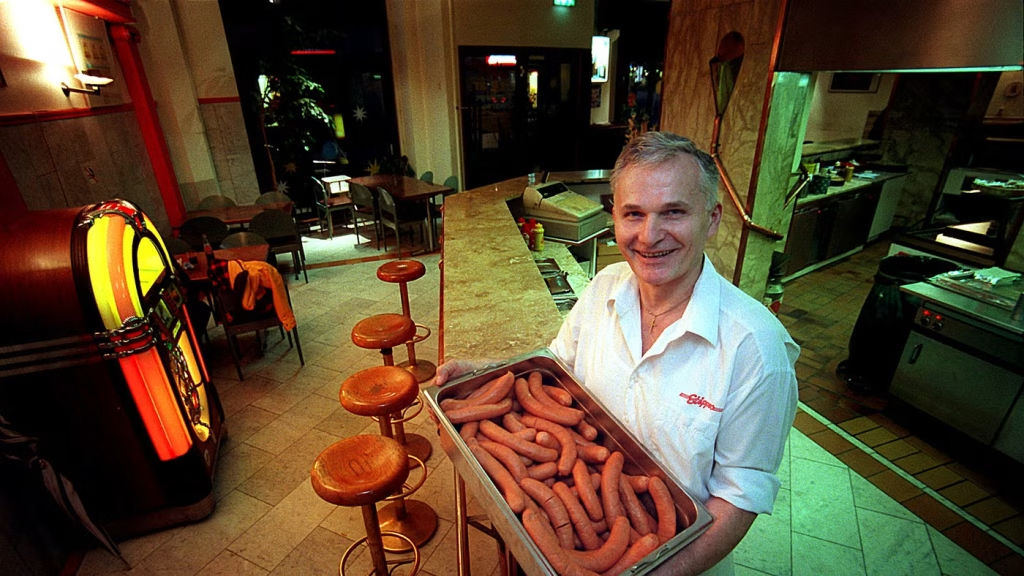
The red sign, the burgers, the spicy sausages, the chips and the unmistakable presence of Stjepan “Stippe” Rasic turned a modest late-night restaurant on Davidshallsgatan into something far bigger than its size. Stippes became a meeting point for taxi drivers, musicians, students, night owls, people living on the margins and people who had simply stayed out much later than planned. Malmö City itself has described it as an institution of the city’s restaurant and nightlife scene, while a 2025 municipal document noted that homeless people were often given a cup of coffee there. citeturn1search27turn1search30
The immigrant who discovered Malmö’s missing meal
The story begins with a young man from Croatia. Stjepan Rasic arrived in Malmö in September 1965, aged 23. His first impression was not exactly the romantic postcard version of Sweden. He later recalled thinking Malmö was a huge country town, with people driving on the “wrong” side of the road and, in his telling, even the toilets and heating arrangements seeming surprisingly old-fashioned. citeturn0search0
But there was one problem that mattered more to a young man who enjoyed going out: Malmö practically stopped serving food when the evening was getting interesting.
Rasic remembered going dancing at Kramer, only to discover that when hunger arrived, the kitchens had already gone home. Bars closed early, cooks disappeared and there was nowhere obvious to get a proper bite. His reaction was wonderfully entrepreneurial: if Malmö could not feed people after the nightlife began, he would.
He spent six or seven years saving money before opening Stippes in February 1972. The basic philosophy was remarkably simple: everybody was welcome. citeturn0search0turn0search24
And then came the “Hungarian” sausage
One of the great Stippes stories begins with a linguistic problem.
Rasic was Croatian and wanted to serve a sausage from his homeland: kranjska, a sausage associated with the former Yugoslav region. But, as he later explained with characteristic humour, Swedish customers struggled to pronounce it. Soon people were calling it “juggekorv”—roughly, “Yugo sausage.”
Rasic and his brother were not enthusiastic about advertising their Croatian sausage that way. So a new name was invented: Hungarian sausage.
It became one of Stippes’ signatures, served with bread, ajvar and pickles. The joke was that the label was easier for Malmö to swallow than the pronunciation. As Rasic himself explained years later, the sausage was not actually Hungarian; the name was essentially a practical piece of marketing. citeturn0search0turn0search24
Corn from a coffee pot—and other early experiments
The early Stippes kitchen was hardly a multinational industrial operation. One of the original specialities was corn on the cob. Rasic bought canned corn from Canada and heated it in a coffee pot. It sounds almost absurdly improvised today, but that was part of the charm: Stippes was built by solving one practical problem at a time.
The formula gradually became familiar—burgers, sausages, chips, ajvar, bread and a level of late-night accessibility that was still unusual. The food was affordable, filling and designed for people who were hungry rather than people trying to impress a food critic.
That distinction mattered. Stippes was democratic food in the best sense: the same counter could serve a taxi driver finishing a shift, a musician coming off stage, students on their way home and a group of friends who had spent the evening celebrating something—or trying to forget something.
Stippe himself was the secret ingredient
Restaurants can copy menus. They can copy interiors. They can even copy opening hours. What they cannot easily copy is a proprietor who becomes part of the city’s personality.
Stippe did.
He was not merely the man who owned the place. He was its social centre. Former employee Göran Lind worked at Stippes for 28 years and remembered the strange emptiness that followed Stippe’s death: no Stippe arriving for his daily sandwich and coffee, no familiar presence behind the institution. citeturn1search0
Musician Jalle Lorensson of Wilmer X remembered something even more important: the way Stippe treated people who lived on the margins. That generosity is echoed in Malmö City’s own account of the restaurant, which notes that homeless people were often offered coffee. citeturn1search0turn1search27
That is a remarkable legacy for a place whose basic business model was, on paper, hamburgers and sausages.
The characters who made the counter come alive
Stippes attracted characters because Stippes was a character itself.
Taxi drivers became part of its unofficial cast. Nightlife regulars knew that if you waited long enough, someone interesting would walk through the door. Musicians and artists mixed with ordinary Malmö residents. A 2002 academic discussion of Malmö identity even singled out Stippe, alongside figures such as Mikael Wiehe and Jacques Werup, as someone who helped shape the city’s distinctive cultural profile. It described Stippes as a place where young people, homeless people and others could end their nights together. citeturn0search25
That mixture produced the kind of anecdotes that are almost impossible to reproduce in a modern restaurant review. Somebody would arrive after a concert. Somebody else would be finishing a taxi shift. Someone would order a burger at an hour when most kitchens had been dark for hours. A regular would sit down for “just five minutes” and discover that half an hour had disappeared.
And because Stippes was Stippes, nobody needed to dress the story up.
The rise: from burger counter to Malmö institution
The remarkable thing about Stippes is that it did not become famous through a carefully engineered brand campaign. It accumulated reputation one customer at a time.
Its late-night role was crucial. Stippes filled a gap in the city’s nightlife infrastructure and became a reliable destination when restaurants closed and clubs emptied. A contemporary Malmö city guide described it as an institution of Malmö nightlife and specifically highlighted its late-night appeal and the “everyone’s welcome” ethos. citeturn0search23
The name eventually became shorthand. You did not always say you were going to get something to eat. You said you were going to Stippes.
That is the moment when a restaurant becomes part of a city’s vocabulary.
The long goodbye
Stippe announced his retirement in 2014 at the age of 72, after almost half a century in Malmö. Yet the institution continued. The business survived its founder’s gradual withdrawal and remained recognisable to successive generations. citeturn0search0
Stippe died on Christmas Eve 2022, aged 81, after a period of illness. His death made clear just how deeply the man and the place had become intertwined. citeturn1search3turn1search0
Then came the final chapter. Stippes AB was declared bankrupt on 10 March 2023. Business records show the company had already seen falling turnover and a loss in 2021, while subsequent reporting confirmed the bankruptcy. citeturn1search5turn1search9
The legendary red sign was saved and taken to Malmö Museum. In 2023, Sveriges Radio reported that the sign was heading into a museum exhibition as a piece of the city’s history. Today the former restaurant is permanently closed. citeturn1search2turn1search6
The final order
There is something fitting about Stippes ending up in a museum.
Most restaurants disappear quietly. A lease expires, the furniture is removed, a new sign goes up and within a few years only the address remains. Stippes was different. Its sign became an artefact because the restaurant had already become an artefact in the memories of Malmö residents.
The history of Stippes is not really the history of a burger. It is the history of a city changing around one stubbornly welcoming little place.
It is the story of an immigrant entrepreneur who noticed a gap in Malmö’s nightlife and filled it. Of a sausage whose name changed because Swedes could not pronounce it. Of corn heated in a coffee pot. Of taxi drivers, musicians, night owls and people on the margins sharing the same counter. Of a proprietor who believed that everybody should be allowed through the door.
And perhaps that is why the legend refuses to disappear.
You can close Stippes. You can take down the red sign. You can serve burgers somewhere else.
But if you grew up in Malmö, there will always be a part of the night when somebody says the magic words:
“Shall we go to Stippes?”
A note on the stories
This editorial combines documented history with recollections and anecdotes from interviews, municipal records, journalism and Malmö cultural sources. Where a colourful detail comes from Stippe’s own recollection or later local memory, it is presented as such. The intention is to capture the character and mythology of Stippes without turning local legend into unsupported fact.
Selected sources
Sveriges Radio interviews and obituaries on Stjepan “Stippe” Rasic; Malmö City municipal documents concerning Stippe and the proposed memorial; Malmö Museum material on the Stippes sign; Fredrik Ekelund’s account of Stippes as a Malmö nightlife institution; contemporary historical material on the “Hungarian sausage”; and Malmö cultural/history references.