
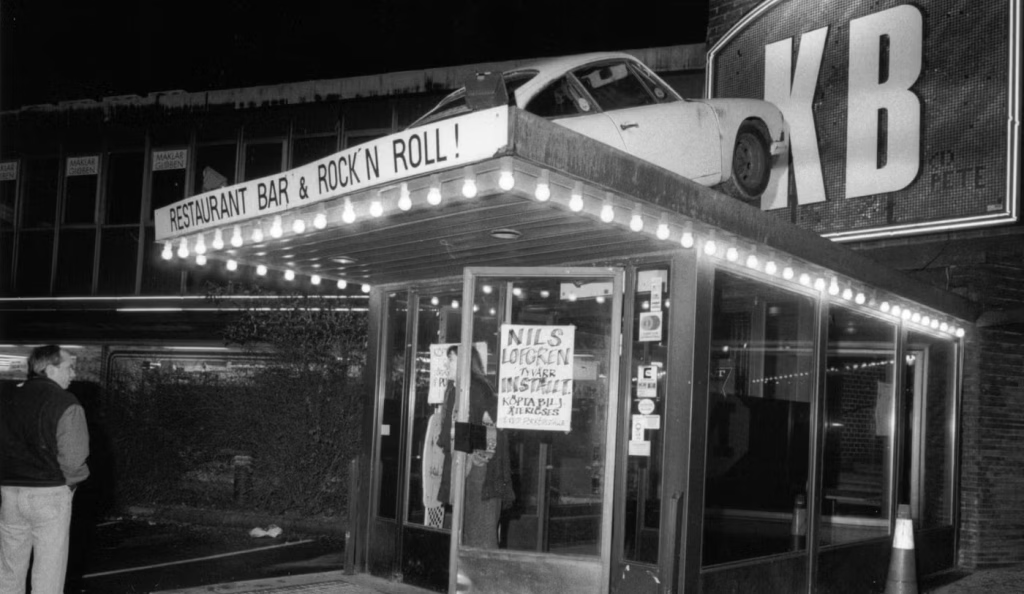
KULTURBOLAGET
The little Malmö rock club that refused to die
It began in Erikslust in 1982. Forty years later, after economic crises, a forced move, legendary concerts, blown fuses, world-famous artists and thousands of late nights, Kulturbolaget finally closed the doors of its legendary Bergsgatan venue. But the story of KB is far from over.
There are music venues, and then there are institutions. In Malmö, Kulturbolaget – universally known simply as KB – became both. It was never the biggest club in Sweden, nor did it have the most glamorous building or sophisticated surroundings. Its appeal was almost the opposite: you could stand practically on top of the stage, drink a beer, sweat through your shirt and watch an international superstar perform only a few metres away. Occasionally, the electricity would disappear. Welcome to Kulturbolaget.
It all began at Erikslust
The story started on 5 February 1982, when Kulturbolaget opened its doors at Erikslust in Malmö. The first concert was opened by Dan Hylander, establishing a tradition that would eventually come full circle four decades later.
The idea was ambitious. Malmö needed a serious rock club, and at a time when the city’s entertainment scene was hardly flourishing, four students decided to take the risk. Their timing proved remarkably good. The early KB quickly established a reputation for booking artists who were exciting, alternative, unpredictable or simply too interesting to ignore.
Then came The Cramps. During their performance, the famously wild American punk-rock band reportedly went so far that singer Lux Interior was practically trying to swallow the microphone. That, ladies and gentlemen, is one way to establish a venue’s reputation.
The little club with very big ambitions
KB’s philosophy was straightforward: book great artists, get them close to the audience and don’t be afraid of music that might scare the neighbours.
Over the years, the list became extraordinary: Nick Cave, The Jesus and Mary Chain, The Gun Club, Van Morrison, Emmylou Harris, Morrissey, The White Stripes, The Strokes, Patti Smith, Slayer, Screamin’ Jay Hawkins and Roky Erickson, among many others.
The remarkable thing was the size of the room. KB wasn’t an arena, or even a particularly large concert hall. Yet artists who could have played considerably bigger venues ended up squeezed into Malmö’s favourite rock’n’roll clubhouse. That intimacy became its secret weapon. At KB, the audience wasn’t looking at a tiny figure on a distant stage; the artist was right there, sometimes almost too right there.
The great escape to Möllan
In 1992, disaster struck. KB was forced to leave its Erikslust premises and find somewhere else to continue. The conflict with the landlord became particularly dramatic. According to the book KB – artisterna, profilerna, historierna, a forklift was driven into the premises while staff had barricaded themselves inside.
A forklift. Into the building.
This was not merely a disagreement about the rent. This was Malmö rock’n’roll.
For a moment, it looked as though Kulturbolaget might disappear altogether. Instead, it did what it had apparently learned to do best: survive.
Bergsgatan 18
In 1993, KB moved into the old premises at Bergsgatan 18, in the heart of Möllevången. The building was still unfinished when the new venue opened, but nobody seemed particularly concerned. On 30 July 1993, Southside Johnny & The Asbury Jukes inaugurated the new stage, and the new KB quickly became one of Malmö’s defining cultural landmarks.
The red-brick building didn’t look particularly revolutionary from the outside. Inside was another story: concerts, club nights, queues stretching along Bergsgatan, sweaty shirts, spilled drinks, ringing ears and the occasional person who had clearly underestimated how loud the evening was going to become. Most importantly, there was music – lots of it.
When the lights went out before Van Morrison
One of the great KB stories concerns Van Morrison. In 1994, the legendary Irish singer was scheduled to perform, and about fifteen minutes before he was due on stage, the main fuse blew.
A disaster? Perhaps. A typical KB moment? Absolutely.
Somehow the show went ahead. Because you could bring Van Morrison to Malmö, but apparently you couldn’t necessarily guarantee the electricity. If Morrison was prepared to wait, perhaps everybody else could too.
Emmylou, Morrissey and the light that never went out
The 1990s turned KB into an international destination. Emmylou Harris played there in 1994, while Morrissey later finished his concert with There Is a Light That Never Goes Out. It was almost absurdly appropriate. By then, KB had already survived one near-death experience, and its light, as it turned out, really wasn’t going out.
The Malmö artists
KB’s importance was never simply about bringing famous international musicians to Sweden. The club became a crucial home for Swedish and Malmö artists, with Wilmer X among its most important regulars.
According to the book about the club, the Malmö band performed at KB 48 times, including an extraordinary run of six sold-out shows across two weekends in 1998.
For local artists, KB could be a proving ground; for established acts, it offered a chance to reconnect with an audience; and for fans, it was somewhere you might discover a band before everybody else caught on. The club’s management had the opportunity to follow artists such as The Ark, The Cardigans and First Aid Kit at different stages of their careers.
That mixture of established names and emerging talent was central to the KB identity.
Totte and the art of survival
One of the central characters in KB’s long story was Totte Lundgren, who became owner from the late 1980s and remained closely associated with the club’s development.
Running a rock club for decades is not a job for the faint-hearted. There are artists who sell out and artists who don’t; equipment that breaks; performers who arrive late and others who arrive early; audiences who behave perfectly and those who emphatically do not. And then there are the bills.
Lots of bills.
Yet Lundgren and the KB team kept going. What began as a risky little rock club eventually grew into one of southern Sweden’s major concert promoters.
From basement rock club to concert empire
After its 25th anniversary, KB expanded dramatically. The organisation moved beyond its own venue and began producing larger concerts and arena shows across southern Sweden.
The names tell the story: Britney Spears, John Fogerty, Rammstein, Robyn and Bob Dylan. From 2007, KB also arranged major concerts at Malmö Stadion featuring artists including Elton John, Kiss, Iron Maiden and The Eagles.
The company became involved in major festivals including Metaltown, Pier Pressure, West Coast Riot, Vanguard and Vi som älskar 90-talet.
The little club had become a serious music business, but the heart remained Bergsgatan.
The final countdown
Eventually, every venue faces the same question: how long can this continue?
In 2022, Kulturbolaget announced that it would leave Bergsgatan after more than 30 years. The company described the departure as the end of an era rather than the end of KB itself.
The final concerts took place in September 2023, and there was something beautifully circular about the ending. The last artist on stage was Dan Hylander, the same man who had opened the original Kulturbolaget in 1982.
The final programme was pure KB: The Hellacopters, Wilmer X, bob hund, Hardcore Superstar, Joddla med Siv, Miriam Bryant and others, before Hylander closed the chapter.
The building was finished.
The story wasn’t.
And then the sign disappeared
In 2024, the physical remains of the Bergsgatan era were scattered. More than 300 items from the club were sold at auction, and even the enormous KB sign came down.
The five-metre-long sign was divided among eight buyers and sold for 27,000 kronor – a slightly surreal ending for an object that had once told thousands of Malmö residents exactly where the night’s trouble was going to begin.
The legacy
So what made Kulturbolaget special? Perhaps it was the stubbornness, the intimacy and the willingness to take chances. More than anything, it was an understanding that great live music should feel dangerous – not dangerous in the literal sense, but in the sense that anything could happen.
The Cramps could attack the microphone. The main fuse could blow before Van Morrison. A forklift could threaten the existence of the entire club. A future superstar could turn up in a tiny room. Thousands of Malmö residents could stand shoulder to shoulder, wondering whether the band on stage was about to become the next big thing.
That’s the magic of a great music venue. It isn’t really the building; it is the accumulated memories.
KB’s Bergsgatan address may be gone, but the noise hasn’t disappeared. It lives in recordings, photographs, stories, sore ears, old concert tickets and the inevitable sentence that begins, “You should have been there…”
And if there is one thing Kulturbolaget taught Malmö over four decades, it is never to underestimate a small rock club. Sometimes the smallest room can contain an entire city’s musical soul.