
TAHONGA
The legendary night that Malmö refused to go home
A GO! editorial special • Malmö, Sweden
There are bars that are remembered for their cocktails, bars remembered for their music, and bars remembered because everybody who mattered—or thought they mattered—seemed to end up there sooner or later. Tahonga was all three. For roughly a quarter of a century, the cocktail and piano bar at Hotel S:t Jörgen in central Malmö became one of the city’s great late-night institutions. It finally closed in 2005, but the stories have proved considerably harder to shut down.
Tahonga was not simply a place to have a drink. It was an after-hours crossroads: politicians, musicians, actors, journalists, businessmen, night owls and assorted characters could occupy the same room. Contemporary and retrospective accounts describe it as an exotic, sometimes gloriously eccentric destination, famous for tropical drinks, piano entertainment and the feeling that the night was not finished until Tahonga said so. It was reportedly open into the small hours—one reason it became a classic final stop in Malmö nightlife.
Born tropical, raised in Malmö
The name had history before Malmö ever heard it. A Tahonga bar had opened in Stockholm in 1973, created by hotelman Charles de Marie and inspired by the culture and atmosphere of the South Pacific. The concept travelled south, and a Malmö Tahonga emerged at Hotel S:t Jörgen around 1980. Accounts place the Malmö bar on the hotel’s upper floor, at the Stora Nygatan/Södergatan location.
Its tropical identity was part theatre, part cocktail craft. Early decorations included tiki figures; later the room evolved through zebra-patterned sofas, oversized rattan lamps and other exotic touches. The original tikis apparently proved rather popular—so popular, in fact, that several were stolen. That may be the most Malmö sentence ever written about a tropical cocktail bar: even the décor wanted to escape after closing time.
The drinks were central to the legend. Mai Tais, a version of the Zombie and other exotic cocktails gave Tahonga a personality that was quite different from the increasingly familiar beer-and-DJ nightlife of later decades. This was a bar where a drink could arrive looking like a small theatrical production.
Donna Jeremias: the woman behind the legend
If Tahonga had a leading character, it was Donna Jeremias. She had already been associated with the Stockholm Tahonga before bringing her experience to Malmö, and later accounts describe her as a pioneering bartender who worked with tropical drinks at a time when the Swedish bar scene was far more conservative.
Her reputation became larger than the bar itself. A later account by a Tiki enthusiast describes Jeremias as a local Malmö legend and recalls her pioneering work with drinks such as Piña Coladas and tall Margaritas, along with her flower-decorated creations. Nöjesguiden later referred to her as one of Malmö’s most legendary bartenders after Tahonga had closed.
There is something wonderfully rebellious about the story. In an era when bartending was still treated by some as a strictly traditional profession, Donna was putting flowers in drinks, embracing tropical flavours and turning the cocktail into performance. Tahonga did not merely serve drinks; it created characters—and the bartender was one of them.
Where politicians met rock stars
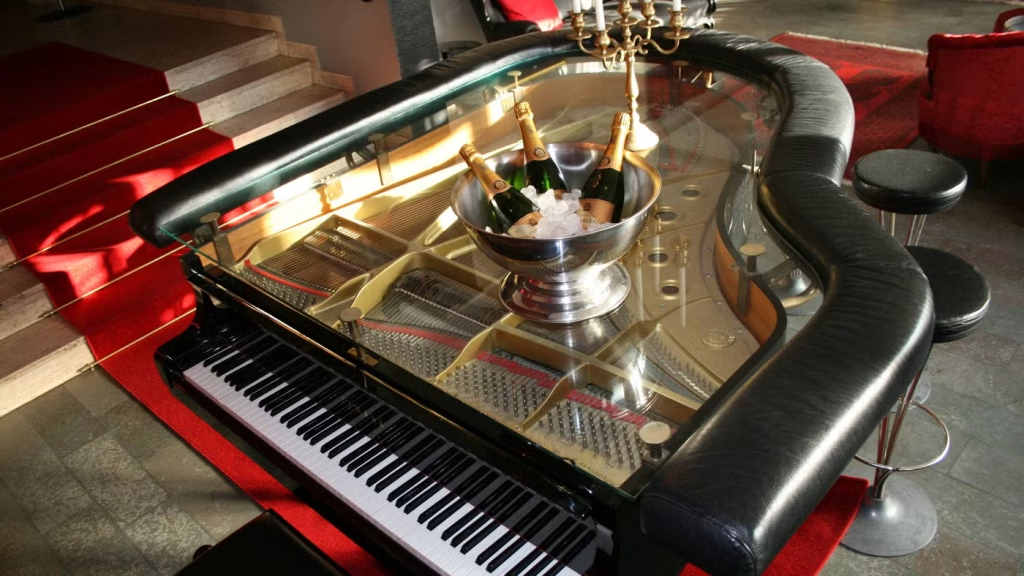
Tahonga’s guest list is part of its mythology. Later accounts connect the bar with Swedish public figures ranging from Olof Palme to The Cardigans, while the bar’s famous piano became almost a character in its own right. The present-day Nöjesteatern in Malmö says its pianobar features the classic Tahonga grand piano and recalls performances associated with figures including Tom Jones, Olof Palme and The Cardigans.
There is even a wonderfully cinematic anecdote involving Tom Jones. Malmö writer Calle Rockbäck recalled a Polynesian mask from Tahonga that later ended up in Lomma. In his telling, the mask had served as an ashtray and conversation companion in the smoky small-hours atmosphere. Rockbäck jokingly imagined it preserving the cigarette ashes of Olof Palme, the pipe smoke of Thorbjörn Fälldin and the cigar of Tom Jones. Whether every last ash belonged to the celebrity named is, naturally, impossible to prove. But that is precisely the point: Tahonga accumulated stories faster than anyone could authenticate them.
The pianist who knew every song
Then there was the pianist. One of the most enduring descriptions of Tahonga concerns the musician who seemed to know every song by heart. Aftonbladet, looking back at Malmö’s hotel-bar culture, remembered that people spoke about the pianist with a slightly mischievous tone—as though everyone knew the legend had become bigger than the man at the piano.
And what did the pianist play? Apparently, whatever the room demanded. In a place where politicians could sit beside performers, hotel guests beside hardcore night owls, the ability to move from one familiar tune to another was almost a superpower. The piano was not background music; it was social glue.
The beautiful, strange mixture
Tahonga’s real magic may have been its mixture. One retrospective description paints a picture of actors, journalists, politicians, criminals, sex workers and other night-time personalities sharing the same late-night watering hole. Another describes it simply as the place where everybody ended up.
That mixture is difficult to manufacture. A modern nightclub can hire a famous DJ, install expensive lighting and design a spectacular cocktail menu. But it cannot easily manufacture the strange chemistry created when completely different people have nowhere else they particularly want to be at 3:30 in the morning.
Tahonga was also part of a disappearing nightlife culture: the hotel bar as neutral territory. You could be a hotel guest or a local. You could arrive dressed for dinner or looking as though you had already survived three other bars. You could come for one drink and leave hours later. And, crucially, nobody needed to ask why you were still there.
From legend to decline
The 1990s brought something of a revival. Tahonga was rediscovered by a younger generation and its name began appearing in popular culture. It was even associated with songs and references from the era, reinforcing the idea that Tahonga was not merely an old-fashioned hotel bar but a piece of Malmö nightlife mythology.
Yet the very qualities that made it legendary could also make it difficult to sustain. By the final years, the place had acquired a reputation for late-night excess and an eclectic clientele that could be as colourful as it was unpredictable. One later account recalls periods when the bar attracted everyone from Hell’s Angels to prostitutes and people simply determined not to go home before dawn. That is not a conventional five-star hotel-bar marketing proposition—but it is an excellent recipe for a legend.
Eventually the world around Tahonga changed. Malmö’s nightlife modernised. New bars, clubs and cocktail venues appeared. The old hotel-bar culture lost some of its special status. In April 2005, Tahonga closed. Contemporary reporting and surviving photographs document an emotional farewell, with regulars gathering for one last evening. Among those remembered in the farewell material were regular patrons such as Lennart Hansson, Helena Bruce and Håkan Bladh—better known as Dr Rock—as well as figures from the Tahonga staff and management.
The afterlife of a bar
The strangest thing about Tahonga is that its physical disappearance did not end its career. Pieces of the place survived. The famous piano found a new life in Malmö theatre culture. Objects and memories scattered into private hands. Photographs remain in archives. Former bartenders carried its traditions into other establishments. And people who were there—or insist they were there—continue to tell stories.
That is how a bar becomes folklore. The details become slightly blurred. Someone remembers a politician at the piano. Someone else remembers a rock star at the bar. A third person remembers a bartender producing a drink that seemed to contain half a tropical garden. Someone remembers leaving at four in the morning. Someone else swears it was five.
And somewhere in the conversation, somebody always says: ‘You should have seen Tahonga.’
Why Malmö still remembers
Tahonga matters because it represents something increasingly rare: a nightlife venue that developed its own mythology organically. It had a distinctive name, a distinctive atmosphere, a distinctive bartender, a distinctive piano and a clientele that could never have been assembled by a marketing department.
It was sophisticated and seedy, glamorous and slightly ridiculous, international and unmistakably Malmö. It could serve an exotic cocktail to a famous guest and a perfectly ordinary drink to a local regular without asking either to explain themselves.
Perhaps that is the secret of its longevity in memory. Tahonga was never just about the drink. It was about what might happen after the drink arrived.
The bar closed in 2005. The night, apparently, never did.
A note on the legends
Tahonga’s history survives through newspaper articles, photographic archives, later recollections, oral history and enthusiast research. Some celebrity associations and colourful anecdotes are documented; others survive as local lore and cannot be independently verified. They are included here as part of the mythology surrounding Tahonga, not as claims that every detail can be proven.
Sources & further reading
Key references consulted include Nöjesguiden’s Malmö bar coverage; Aftonbladet’s retrospective on Malmö hotel-bar culture; Scandic’s historical account of the Stockholm Tahonga; surviving Tahonga documentation and images from Bilder i Syd; Tiki Central’s historical research on the Malmö and Stockholm Tahonga bars; and Malmö-related recollections and cultural references including Nöjesteatern and Calle Rockbäck.