
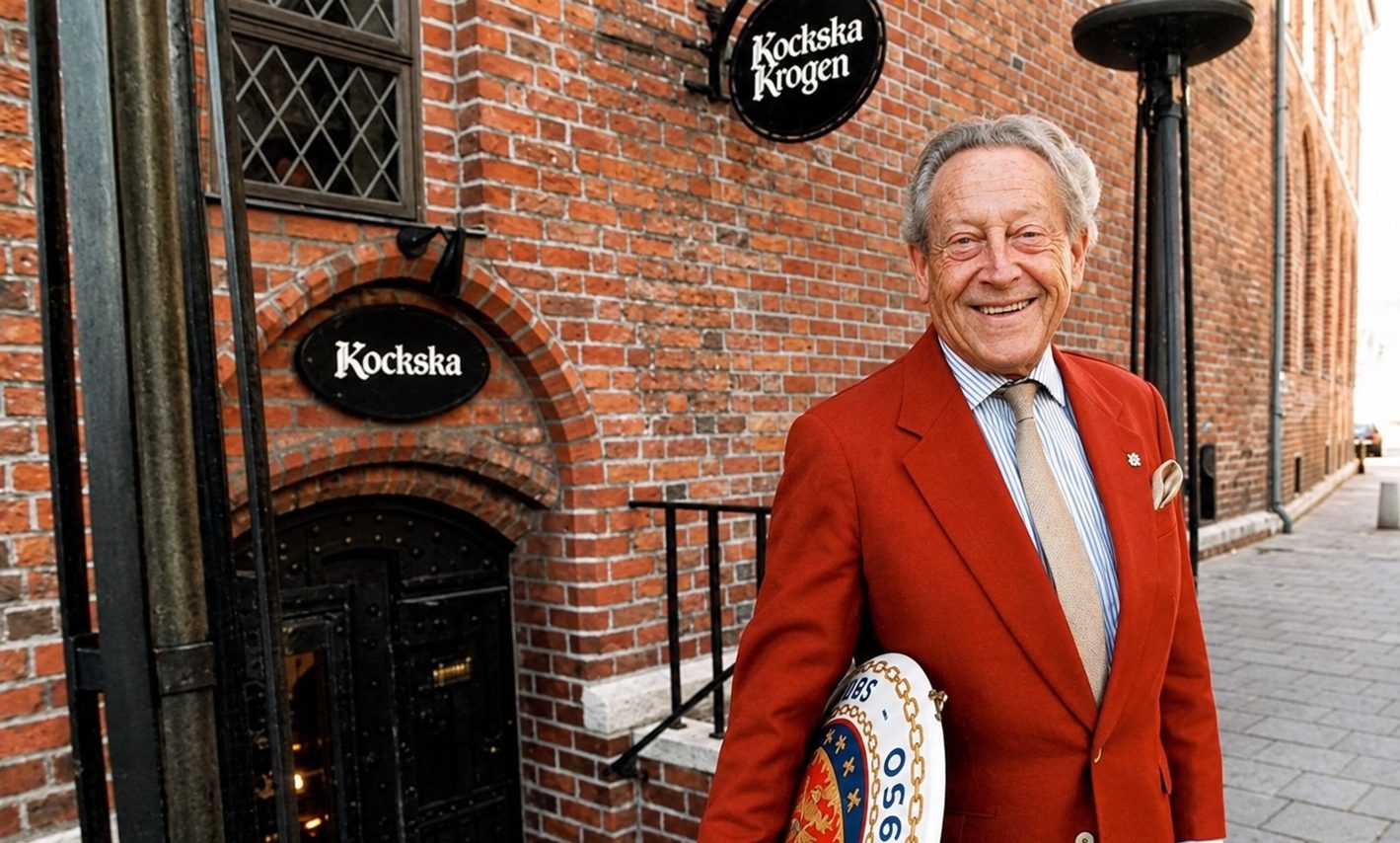
KOCKSKA KROGEN
The legendary Malmö restaurant where history, fine dining and larger-than-life characters met beneath the vaults
There are restaurants that serve dinner.
And then there are restaurants that become part of a city’s mythology.
For decades, Kockska Krogen was one of Malmö’s great institutions – a restaurant where the food mattered, certainly, but where the setting, the personalities and the stories around the tables became almost as important as what arrived on the plate.
Hidden beneath the magnificent historic Jörgen Kocks house in central Malmö, Kockska Krogen occupied a setting that was almost impossible to compete with. The brick vaults had already witnessed several centuries of Malmö life before the first modern restaurant guest sat down to dinner. The restaurant opened in 1967 under legendary restaurateur Lars Lendrop and eventually became one of the city’s best-known fine-dining addresses.
And, naturally, a place like that collected stories.
Lots of them.
A house older than almost every Malmö restaurant
To understand Kockska Krogen, you first have to understand the building.
Jörgen Kocks house dates from the 1520s. Its builder, Jörgen Kock, was not exactly an ordinary Malmö citizen. He was the city’s mayor and a royal mint master – effectively one of the most powerful financial figures in Malmö during the period when the city was still part of Denmark. Malmö Stad describes the property as one of the finest surviving examples of 16th-century brick architecture in Scandinavia.
The building has therefore seen almost everything.
Merchants came and went. Fortunes were made and lost. Wine and provisions were stored beneath the ancient vaults. Conversations about money, politics, romance and business have presumably been taking place there for centuries.
Kock himself would probably have recognised the fundamental idea behind the restaurant immediately:
Put people around a table, give them something good to eat and drink, and see what happens.
The building had already had connections with tavern life going back to the 17th century.
But the great modern chapter began in 1967.
Enter Lars Lendrop
Lars Lendrop was the man who looked at those ancient cellars and saw not just history, but a restaurant.
In 1967 he opened Kockska Krogen.
It was an inspired piece of restaurant theatre. Instead of trying to hide the age of the building, the restaurant embraced it. Guests descended into the atmospheric cellar beneath the old house, surrounded by heavy brick vaults and the unmistakable feeling that they were dining somewhere that had been waiting centuries for them.
Lendrop was part of a prominent Malmö restaurant tradition and had learned the trade at the Grand Hotel Savoy, where his father Fritz Lendrop was also involved in the business.
Kockska Krogen quickly developed its own identity.
This was not the kind of restaurant where you simply popped in for a quick bite.
It was an occasion.
Suells sula – Malmö on a plate
Every legendary restaurant needs a signature dish.
Kockska Krogen had one with a wonderfully Malmöesque name: Suells sula.
The dish was essentially a double-cut beef preparation with a filling – a substantial piece of food with enough character to suit the surroundings. Malmö Museum specifically records Suells sula as one of the restaurant’s memorable specialities.
And the name was no coincidence.
Frans Suell was another towering figure in Malmö history. The merchant and industrialist was associated with the house centuries after Jörgen Kock, and the old building continued to carry his name and associations.
So while diners ate Suells sula beneath Kock’s vaults, Malmö’s history was almost literally being served back to them.
Imagine explaining that to a modern restaurant consultant.
“We need a signature dish.”
“How about a double steak named after an 18th-century Malmö merchant?”
Somehow, it worked.
Where famous people became part of the story
Kockska Krogen was not merely a restaurant for anonymous diners.
Over the years, the old vaults attracted people whose names already belonged to Malmö’s cultural mythology.
Among them was Anita Ekberg.
Born in Malmö, Ekberg went on to become Miss Sweden, an international film star and one of the great glamour icons of the 20th century. Her association with Federico Fellini’s La Dolce Vita and the famous Trevi Fountain scene turned her into an international celebrity.
When Ekberg returned to Malmö in 1982, she visited Kockska Krogen.
It was a wonderful full-circle moment.
The Malmö girl who had left for an extraordinary international career was now sitting beneath the ancient vaults of a restaurant that itself seemed to belong to another century.
And there was another name hovering around the story:
Frank Sinatra.
Sinatra had connections to Malmö and to the restaurant world surrounding Lars Lendrop. He had also been romantically involved with Anita Ekberg and had reportedly proposed to her.
She said no.
That little detail alone sounds like something invented by a screenwriter.
But it happened.
Ekberg chose to remain Miss Ekberg rather than become Mrs Sinatra. The two remained friends, and their intertwined story became another fascinating thread in the mythology surrounding Malmö, Lendrop and Kockska Krogen.
One can only imagine what the old brick walls would have made of that conversation.
A restaurant with a certain attitude
By the 1980s and 1990s, Kockska Krogen had established itself firmly in Malmö’s restaurant history.
But legends are rarely universally loved.
A fascinating contemporary review from September 1995, written by Sydsvenskan’s restaurant critic Bong, provides a glimpse of the restaurant during its final years. The reviewer admired the historical setting but found the cellar somewhat dark and the atmosphere rather formal. The staff, he suggested, possessed a certain distance – more “dignified institution” than exuberant hospitality.
It is actually a wonderful description of an older style of Swedish fine dining.
There was a time when a waiter did not necessarily need to smile at you every seventeen seconds.
The message could be:
You are dining in an important restaurant. Behave accordingly.
Perhaps the darkness beneath the vaults helped.
Perhaps it was the wine.
Perhaps the staff simply knew something the customers didn’t.
The rise – and the fall
Kockska Krogen’s story is ultimately a story of transition rather than a spectacular collapse.
The restaurant had enjoyed decades of recognition, but by the 1990s the Malmö restaurant scene was changing. Dining culture was becoming more contemporary, more informal and increasingly international.
In 1997, the Kockska Krogen era came to an end when Årstiderna moved into the historic premises.
For some old Malmö residents, that must have felt like the end of an institution.
But in another sense, it was simply the next chapter.
The restaurant name disappeared.
The building remained.
The vaults remained.
And, most importantly, the tradition of gathering around a table remained.
The joke is that the building won
This may be the most remarkable part of the whole story.
Kockska Krogen is gone.
Lars Lendrop’s restaurant belongs to Malmö’s past.
The diners who once filled the cellar have grown old, moved away or become stories themselves.
But Jörgen Kocks house is still there.
The same walls that witnessed 16th-century Malmö later sheltered Frans Suell’s world, then Lars Lendrop’s restaurant, then Årstiderna. Today the historic premises continue to be used for dining and hospitality.
In 2018, Årstiderna was even named Årets Klassiker at the Swedish Restaurant Gala – an acknowledgement that the location had retained its extraordinary place in Malmö’s culinary landscape.
That is perhaps the perfect ending to the Kockska Krogen story.
The restaurant changed.
The names changed.
The menus changed.
The fashions changed.
But people still descend beneath those old brick arches to do exactly what Malmö residents have been doing for centuries:
Eat. Drink. Talk. Celebrate. Gossip. Make deals. Fall in love.
And occasionally tell a story that becomes considerably better after the second glass of wine.
The Kockska Krogen legend
Perhaps that is why Kockska Krogen remains fascinating today.
It wasn’t simply a restaurant.
It was a meeting place between Malmö’s past and present.
Jörgen Kock had his money, power and beer cellars.
Frans Suell had his commerce and wine.
Lars Lendrup had his restaurant and his eye for atmosphere.
Anita Ekberg brought Hollywood glamour back to her home city.
Frank Sinatra brought an almost unbelievable connection to the story.
And generations of ordinary Malmö residents supplied the most important ingredient of all:
The stories
Because restaurants disappear all the time.
Menus become obsolete. Interiors are renovated. Owners change. New concepts arrive.
But a restaurant that becomes part of a city’s collective memory is harder to erase.
Kockska Krogen may have closed its doors as a restaurant in 1997, but its legend never really closed.
It simply moved upstairs, into the history books – and into the memories of everyone who once sat beneath those extraordinary vaults.
And if those walls could talk?
Well, Malmö might have to build a second city hall just to hold the stories.
Kockska Krogen: gone from the menu, but never quite gone from Malmö.