
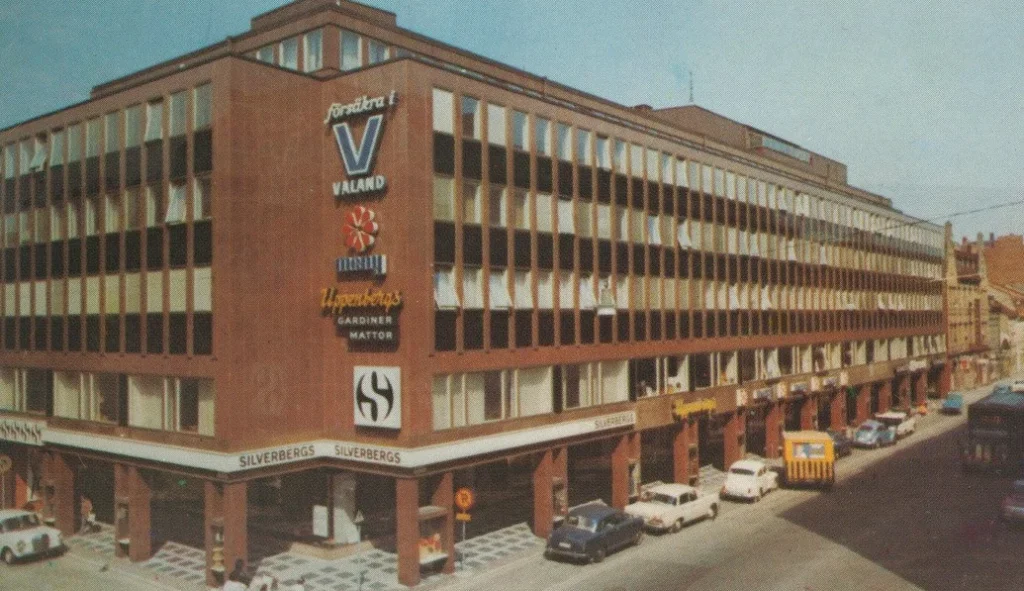
Silverbergs - When one mans dream about design furniture came to town
SILVERBERGS
The Malmö furniture store that taught a city to love design
Long before “design destination” became fashionable language, Malmö had Silverbergs. For generations, the legendary furniture and design store offered everything from Scandinavian classics and Italian furniture to porcelain, glass, lighting and objects that many customers probably had no idea they needed until they saw them. More than a shop, Silverbergs became part showroom, part cultural institution and part education in how to live beautifully.
There are furniture shops, and then there are furniture shops that become part of a city’s collective memory.
Silverbergs belonged firmly to the second category. For generations of Malmö residents, the name meant much more than sofas and dining tables. It represented taste, curiosity and a slightly glamorous glimpse of a world beyond the ordinary Swedish living room.
At the centre of it all was Gunnar Silverberg, a furniture dealer whose career began in his father Axel’s furniture workshop and eventually turned a local business into one of southern Sweden’s most significant furniture stores.
From workshop to Malmö institution
Gunnar Silverberg opened his own furniture shop on Baltzarsgatan in Malmö during the 1940s. When the property was later scheduled for demolition, he moved into three floors in the newly built Valand Building. The larger premises allowed the business to develop into something considerably more ambitious than a conventional furniture retailer.
Silverberg was not interested in treating furniture as an isolated commodity. His interests extended into decorative arts, Oriental porcelain, Scandinavian ceramics and design, and he travelled to places including China and London in search of objects and ideas. The breadth of his own collection later revealed just how wide-ranging that curiosity had become.
The result was a store where furniture could sit alongside glass, porcelain, lighting and decorative objects. Customers might have entered looking for a sofa and discovered an entirely different way of thinking about their homes.
Silverbergs looked beyond Sweden
One of the store’s defining characteristics was its strong connection to Danish and international design.
Silverbergs became known for its Danish furniture, while its wider selection reached into Italian and Scandinavian design. A later account of the store recalls a remarkable 2,000-square-metre environment in central Malmö where everything from Chesterfield sofas to exclusive Italian and Danish furniture could be found.
That international outlook suited Malmö perfectly. Copenhagen was only a short journey across the Öresund, yet the design world represented by Silverbergs could feel much further away from the ordinary Swedish furniture shop.
The store was effectively bringing the outside world into Malmö.
And it did so at a time when good design was still something many people had to actively seek out.
The chair that looked like it came from space
Silverbergs was not afraid of furniture that demanded attention.
A particularly memorable example was the Ovalia chair, designed by Danish designer Henrik Thor-Larsen in 1968. Its futuristic egg-shaped form looked less like traditional Scandinavian furniture than something that might have been installed on a spaceship.
An early Ovalia bought at Silverbergs in Malmö in the late 1960s was later acquired by Sweden’s Nationalmuseum.
This was the spirit of Silverbergs at its best. The store did not simply offer safe choices for customers furnishing a conventional home. It also introduced Malmö to objects that could make people stop, stare and ask the inevitable question:
“Would that actually look good in my living room?”
Silverbergs’ answer, presumably, was that it was worth finding out.
When the famous came shopping
The store’s reputation extended well beyond Malmö’s design-conscious customers.
One of the most entertaining pieces of Silverbergs history is Gunnar Silverberg’s guestbook, which collected signatures and drawings from a remarkable parade of visitors. Among them was Yves Saint Laurent, who visited Malmö in October 1966 during a fashion event and stopped at Silverbergs. He signed the guestbook and drew a fashion illustration that he dated and signed himself.
The guestbook also included names such as Hans Alfredson, Christina Schollin, Jan Malmsjö, Brita Borg, Martin Ljung, Svend Asmussen, Brasse Brännström and Lauren Bacall, among many others. Some left drawings as well as signatures.
Then there was Harry Nilsson.
A 1969 film shows the American singer browsing the original Silverbergs store in Malmö while Everybody’s Talkin’provides the soundtrack. It is an extraordinary little piece of cultural history: one of America’s best-known singer-songwriters wandering through a Malmö furniture store at the height of the design era.
Silverbergs had become the sort of place where a furniture purchase could sit comfortably alongside celebrity culture, fashion and the international design scene.
Gunnar Silverberg: the man behind the taste
The personality of Gunnar Silverberg was central to the store’s identity.
He had the background of a craftsman but the curiosity of a collector. His travels, his interest in Asian porcelain and his enthusiasm for Scandinavian design gave the business a breadth that would have been difficult to achieve through conventional furniture retail alone.
His personal collection eventually demonstrated just how far that curiosity extended. When it was auctioned in 2026, the collection comprised around 100 lots spanning furniture, ceramics, porcelain, glass, art, textiles and decorative objects. Even after his 100th birthday, he was described as remaining intensely curious about the world around him.
That quality seems to have been reflected in the store itself.
Silverbergs encouraged customers to look beyond the obvious. A dining table was not simply a dining table; a lamp could change a room, a chair could alter its character, and a piece of porcelain could become the object around which everything else was arranged.
The shop was selling furniture, certainly, but it was also selling confidence in one’s own taste.
The golden years
At its height, Silverbergs occupied an unusual position in Malmö. It was aspirational without being purely inaccessible, and it offered enough variety to make browsing worthwhile even when there was no intention to buy.
That distinction mattered.
A furniture store that gives customers ideas can become part of a city’s culture in a way that a conventional retailer rarely does. Silverbergs became somewhere people went to see what was happening in design, to discover new names and to imagine a more adventurous home.
For younger designers and furniture professionals, the influence could be particularly strong. One later account recalls how a generation grew up surrounded by the design world associated with Silverbergs, with visits to international furniture fairs and exposure to new designers becoming part of that environment.
The store helped train the eye.
When the world changed
Eventually, however, the retail landscape changed faster than Silverbergs could.
Furniture became increasingly available through larger chains and specialist retailers, while international design became easier for ordinary consumers to discover. The exclusive world that had once required a visit to a destination store was gradually spreading into a much wider marketplace.
Silverbergs finally closed in 1995.
For Malmö, it marked the end of an era.
The building disappeared from everyday life, but the furniture did not. Chairs, tables, lamps, ceramics and other pieces continued to circulate through homes and, eventually, auctions. The name Silverbergs became something of a secret password among collectors: if a piece came with Silverbergs provenance, it immediately carried a little extra Malmö history.
A shop that refused to stay dead
Furniture has an amusing habit of outliving the businesses that sell it.
A shop closes, but the chair remains. The table is passed to another generation. The lamp moves from one apartment to another. Eventually someone discovers it at an auction and realises that it once stood in the window of a legendary Malmö store.
That is part of the reason Silverbergs never completely disappeared.
And in 2026, the name returned to the city.
Silverbergs, reimagined
In April 2026, SLVRBRGS opened on Skomakaregatan near Lilla Torg, deliberately taking its name and inspiration from the original Silverbergs. The new concept is not a conventional furniture store. Instead, it combines interiors, vintage, fashion, books, music, art, plants, food and a café with exhibitions, events and other cultural activity.
The people behind the revival include design figure David Carlson and entrepreneur Anders Sjöstedt, who have described the ambition as creating a destination with the same sense of inspiration associated with the original store.
The timing feels almost suspiciously appropriate.
Malmö has changed enormously since Gunnar Silverberg opened his first shop, but the city still responds to places that offer more than straightforward retail. People want to discover things, meet others, encounter unexpected objects and leave with ideas as well as shopping bags.
In that respect, the new SLVRBRGS is less a reconstruction than a continuation of the original philosophy.
The legacy of Silverbergs
The story of Silverbergs is ultimately about more than furniture. It is about the role a retailer can play in shaping a city’s taste.
Gunnar Silverberg created a place where Malmö could encounter Danish modernism, Scandinavian craftsmanship, international furniture, Asian porcelain and decorative arts without having to leave town. His customers were not simply buying objects; they were being introduced to a broader visual culture.
That is why the store remains so memorable.
Silverbergs made furniture feel cultural and shopping feel like discovery. It gave Malmö a destination where an unusual chair could start a conversation, where a famous designer might sign a guestbook, and where a customer could walk in looking for a sofa and walk out wondering whether the entire living room needed reconsidering.
The original store closed in 1995, but its influence proved harder to remove than its sign.
Today, with the Silverbergs name once again above a Malmö doorway, the story has acquired a rather satisfying final chapter.
The furniture may have changed. The format certainly has.
But the old idea remains: give people something beautiful, unexpected and worth talking about, and they will keep coming back.