Golden Days - "elephant's ear" and spike piano
GOLDEN DAYS
The Malmö restaurant where the night always seemed to have one more round
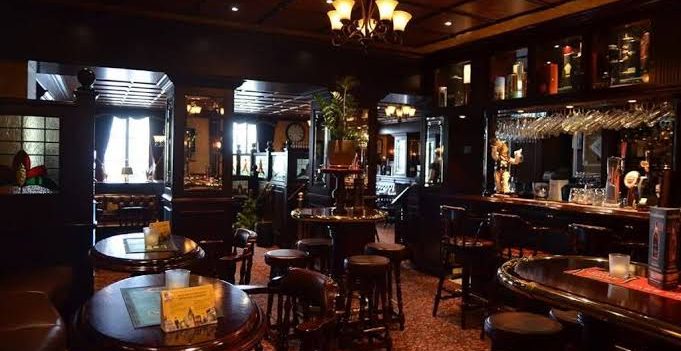
On Stora Nygatan, Golden Days became one of those Malmö places that was much more than a restaurant. It was a pub, a bar, a meeting point and, for generations of regulars, almost an extension of the living room. With British-style surroundings, reasonably priced food, drinks, entertainment and music, it was the kind of place where you could arrive for dinner and discover several hours later that you had somehow become part of the furniture.
A golden name in the heart of Malmö
Long before Malmö became filled with wine bars, craft-beer taprooms and restaurants competing to be the city’s next “destination”, there were establishments whose greatest attraction was simply that everybody knew where they were.
Golden Days was one of them.
The restaurant stood at Stora Nygatan 59, right in the centre of Malmö. A surviving 1980s advertisement describes it as a “popular meetingpoint in the centre” and promotes a varied, reasonably priced menu in a friendly British atmosphere, alongside a pub, cocktail bar, roulette and darts.
That combination tells you quite a lot about Golden Days. It was not trying to be a temple of gastronomy. It was designed to be somewhere you could actually spend an evening.
And Malmö did.
The English pub arrives in Malmö
Golden Days belonged to a generation of Swedish restaurants that borrowed heavily from the British pub tradition. Darker interiors, substantial food, beer, cocktails, games and a social bar gave the concept an atmosphere that was still relatively exotic in Sweden.
The idea worked particularly well in Malmö. The city had always looked across the Öresund, and the English pub aesthetic fitted naturally into a place where international influences arrived early.
By the 1980s, Golden Days was established enough to appear in international promotional material alongside Golden Days establishments in Stockholm and Göteborg. The 1986 material lists Malmö, Stockholm and Göteborg together and presents the concept as a friendly British-style restaurant and pub.
For a city that was rapidly changing, Golden Days offered something reassuringly familiar.
You knew roughly what you were going to get: a table, something to eat, something to drink and probably somebody you knew already sitting nearby.
The great Malmö meeting place
The restaurant’s real success, however, was not the décor or even the menu. It was the clientele.
Golden Days became one of those places where different parts of Malmö’s social life crossed paths. Office workers came after work. Friends met for dinner. Regulars occupied their favourite places at the bar. Younger people discovered the pub atmosphere, while older customers treated it almost as their private club.
The boundaries between restaurant and pub were deliberately blurred.
You could come in for a meal and stay for a drink. You could come in for one drink and somehow still be there when the music started. You could meet somebody you had not seen for months, which naturally meant another round, and that in turn made leaving increasingly theoretical.
That is how a restaurant becomes an institution.
When the bar became the destination
Golden Days was particularly well suited to the Malmö habit of making an evening out of very little.
A dinner did not have to end with the coffee. The bar offered another stage to the evening, and entertainment and live music helped turn the restaurant into somewhere people went not simply to eat but to stay.
A contemporary 1986 advertisement specifically promoted the combination of pub, cocktail bar, roulette and darts, giving the place an almost clubhouse quality.
Later descriptions of the Malmö restaurant, by the 2000s, show that the concept had evolved more explicitly into an English pub and restaurant. A 2006 retrospective in Sydsvenskan described Golden Days as a restaurant with an English pub identity, reflecting how the establishment had adapted as Malmö’s restaurant scene became increasingly international.
But for many regulars, the most important part was still the atmosphere.
The kind of atmosphere that cannot be designed by an interior decorator.
It develops when the same people return often enough to know each other’s stories.
The characters made the place
Every legendary pub has its characters, and Golden Days was no exception.
There were the regulars who appeared so frequently that staff could probably have taken their orders before they had removed their coats. There were the businessmen who came in for a “quick drink” and discovered that their definition of quick was considerably more optimistic than everybody else’s.
There were musicians, night owls, social butterflies and people whose greatest talent was knowing exactly who else was going to be in the bar that evening.
And then there were the storytellers.
Every established Malmö pub eventually develops a mythology of its own: the table that allegedly belonged to a particular regular, the night that went on until breakfast, the musician who could turn an ordinary evening into a performance, or the customer who announced that he was leaving approximately six times before actually reaching the door.
Whether every story happened exactly as remembered is almost beside the point.
Pub history is rarely written by historians. It is written by people who were there, usually several years later and occasionally after a drink.
The music factor
Live music gave Golden Days another dimension.
A restaurant with a bar can be busy. A restaurant with a bar and live music can become a destination.
Music changes the behaviour of a room. People stay longer, conversations become louder, strangers start talking to each other and suddenly the bar feels less like a business and more like a gathering.
Golden Days belonged to that tradition of Malmö venues where music was part of the evening rather than a separate concert experience.
For musicians, such rooms could be particularly important. They were places to build a following, experiment with material and learn how to read a crowd. For customers, the attraction was more immediate: you never quite knew whether the evening would turn into something memorable.
The Golden Days routine
The classic Golden Days evening probably began innocently enough.
“Let’s have something to eat.”
Then came the drink.
Then somebody suggested staying for the music.
Then somebody else arrived.
By that point, going home would have meant abandoning the evening just when it was getting interesting.
This was the great strength of places like Golden Days. They did not require an occasion.
You did not need a birthday, anniversary or corporate event. You simply needed to be in Malmö.
The restaurant supplied the excuse.
A city begins to change
But restaurants, like cities, have life cycles.
Malmö’s restaurant culture changed dramatically from the 1980s into the 1990s and beyond. New cuisines arrived, cafés became fashionable, nightclubs changed character and younger customers began looking for different kinds of experiences.
The old English-pub model remained attractive, but it was no longer quite as unusual as it had once been.
Golden Days adapted. By 2006 it was being described as an English pub rather than the broader restaurant-and-entertainment concept that had characterised earlier years.
That evolution is important because the fall of a legendary restaurant is rarely caused by one dramatic event.
Usually it happens gradually.
A few regulars stop coming. A new place opens. The music changes. The neighbourhood changes. The younger generation finds somewhere else to meet.
One evening you realise that the people who used to make the place feel essential are no longer there.
The end of an era
Today, Stora Nygatan 59 remains a restaurant address, but Golden Days itself belongs to Malmö’s past. The address is now occupied by Rosegarden Malmö, a completely different restaurant concept.
And that may be the strangest part of remembering an old restaurant.
You can stand outside the building and know exactly where it was, yet the place you remember is no longer physically there.
The walls may remain. The address remains. The street remains.
But the voices have gone.
Why Golden Days still matters
Golden Days deserves its place in Malmö’s restaurant history because it represented something that has become increasingly difficult to recreate: a genuinely mixed social meeting place.
It was restaurant, pub, cocktail bar and entertainment venue at the same time. Its surviving advertising captures that spirit remarkably well: affordable food, British atmosphere, drinks, games and a central location.
It was not trying to become a legend.
That is probably why it did.
Ask former regulars what they remember and the answer is unlikely to be a particular menu item. They will remember a person, a bartender, a musician, a table, a ridiculous night, a conversation that went on far too long or the friend who was supposed to leave half an hour ago.
That is the real history of Golden Days.
It was a place where Malmö came to meet itself.
And for a long time, on Stora Nygatan, the night always seemed to have room for one more drink, one more song and one more story.
Golden Days may have disappeared from Malmö’s restaurant map, but for those who remember it, the sign is still glowing.