
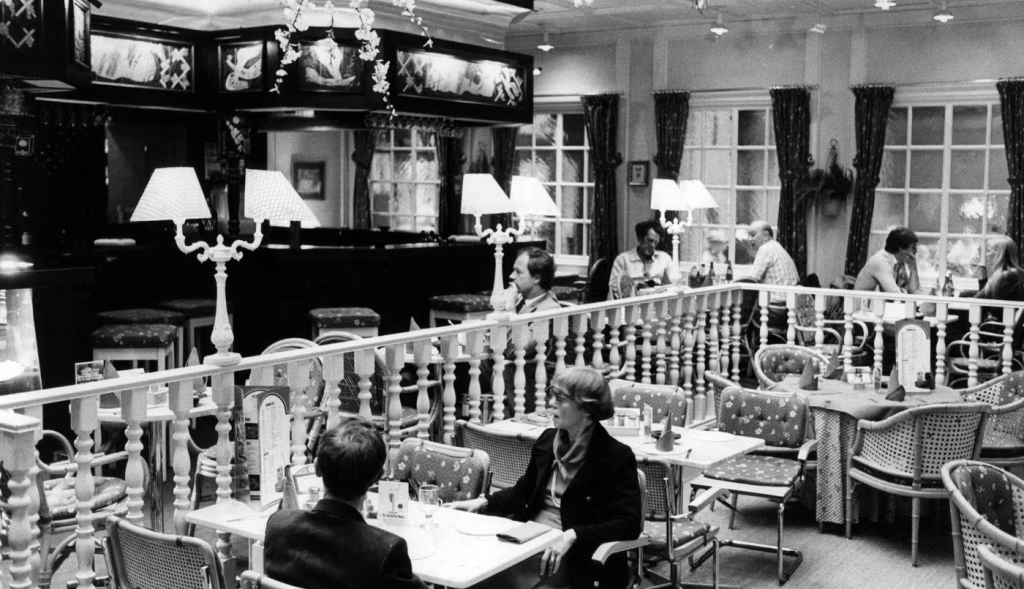
Centralens restaurang - All aboard for food and fun
CENTRALENS
The Malmö restaurant and pub where the night never seemed to end
At Malmö Centralstation, where most people think about departure boards, delayed trains and finding the right platform, there was once another reason to linger. Centralens Restaurang & Pub became one of Malmö’s great meeting places: a restaurant, bar and live-music venue where commuters, railway workers, office employees, musicians, artists, night owls and people who had absolutely no intention of catching the next train could all end up around the same tables.
There are places in a city that people remember because they were beautiful or fashionable. Then there are places remembered simply because everybody went there.
Centralens Restaurang & Pub belonged to that last category.
At Malmö Central, one of the city’s great crossroads, Centralens became much more than somewhere to eat before catching a train. It was a restaurant, pub and music venue with an atmosphere that made the railway station feel less like a place of departure and more like a place to stay. The address was almost impossible to forget: Malmö Centralstation, Centralplan.
A restaurant in the heart of Malmö
The surroundings already had a remarkable history. Malmö’s first railway station opened in the 1850s, linking the city with Lund and placing it strategically close to the ferries to Copenhagen. The original station was badly damaged by fire in 1866, and the present main station building was inaugurated in 1872. Further expansions followed as Malmö developed into one of southern Sweden’s most important railway centres.
Restaurants and cafés were naturally part of that environment. Eating at the station was hardly a new idea, but Centralens took the concept somewhere else. It became a place where people went not merely because they were travelling, but because they wanted to meet.
That distinction is what turned a station restaurant into an institution.
The place where the evening began
Centralens developed a reputation as one of those Malmö places where “just having a drink” was a dangerous phrase. You could meet somebody after work for a beer, discover that a friend was already there, stay for the music and eventually realise that the train you had intended to catch had ceased to be relevant several hours earlier.
Contemporary recollections of Malmö nightlife describe Centralens as a regular stop during the 1980s, particularly for people working nearby. It was close enough to become a natural after-work meeting point before the evening continued elsewhere — assuming it continued at all.
That was one of its great advantages. You did not have to organise an evening around Centralens. If you were already in the city, Centralens was simply there.
The music gave it a soul
Live music was central to the atmosphere, and few musicians are more closely associated with the place than Steve Grahn.
Grahn was an important figure in Malmö’s blues and roots scene, and for around two decades he and guitarist Lasse Bergrensson played regularly at Centralens. Their acoustic repertoire drew heavily on blues and folk, giving the pub a musical identity that was intimate rather than spectacular.
This was not an arena show and certainly not a polished corporate entertainment package. The musicians were close to the audience, the tables were close to the musicians, and the conversation around them was part of the soundscape.
That kind of room creates its own characters. There was always the regular who knew every song, the customer who arrived early enough to claim a favourite table, and the person who announced that he was staying for one drink and was still there long after the musicians had packed up.
Centralens was particularly good at collecting such people.
A railway station with a pub attached
There was something fitting about the clientele. Railway stations naturally bring together people who are between places, and Centralens attracted people who were between plans.
A businessman could end up beside a railway employee. An office worker could sit with a musician. Someone waiting for a train might begin talking to a stranger who had just arrived from Copenhagen. Malmö’s position between Sweden and Denmark gave the station an international rhythm, while the pub gave that movement somewhere to pause.
Outside, trains arrived and departed. Inside, the evening could remain almost completely stationary.
The unofficial after-work headquarters
For many regulars, Centralens belonged to the transition between the working day and Malmö nightlife. A drink after work could become dinner, dinner could become music, and music could become a late night. One recollection of the period even describes people returning to work after a night out and sleeping there before starting again.
Whether every such story happened exactly as remembered is almost beside the point. That is how Centralens survives in local memory: as the place where the normal rules of time became somewhat flexible.
The station timetable remained precise.
The customers were less so.
No need for a complicated identity
Centralens did not need to be “the hottest new venue” or “Malmö’s most exclusive bar.” It was simply Centralens, and that was enough.
Its strength was the absence of pretension. You could arrive in work clothes, a suit, jeans or carrying a suitcase. Nobody needed to explain why they were there. You might genuinely be waiting for a train, meeting somebody after work, listening to music or simply looking for somewhere to spend the evening.
The restaurant and pub therefore became a kind of unofficial social club for the city. It was not exclusive because it was difficult to enter; it was exclusive in the opposite sense. Everybody felt entitled to be there.
When the station changed
Malmö Central itself has never stopped evolving. The station has been rebuilt and extended repeatedly since the nineteenth century, including major changes in the 1920s and the opening of the City Tunnel in 2010. Its historic halls remain protected as part of a listed building complex.
Those changes also altered how people moved through the station.
The old waiting halls gradually acquired new functions. From 2011, parts of the historic station were transformed into an indoor food street, with numerous small restaurants and food businesses. More recently, the station’s restaurant areas have again been redesigned as a modern food court, explicitly drawing inspiration from the building’s history.
The connection between Malmö Central and food therefore survived.
What disappeared was the particular social world of Centralens.
The slow fall of an institution
There was no single dramatic evening when Malmö woke up and discovered that Centralens had vanished. Institutions like this tend to disappear gradually.
The regulars get older. New customers find other places. Musicians move on. The surrounding neighbourhood changes. The building itself is adapted to new uses.
Eventually, a place that once seemed permanent becomes something people describe with the words “Do you remember…?”
That may be the most reliable sign that a Malmö institution has become legendary.
Centralens belonged to an era when one venue could comfortably be restaurant, pub, meeting place and music club at the same time. As nightlife became more specialised and the railway station increasingly became a place designed around passenger flows, the old model became harder to sustain.
Centralens had thrived on people staying.
The modern station increasingly encouraged people to keep moving.
What remains
The physical traces of Centralens are modest compared with the size of its reputation. What remains is largely anecdotal: a musician remembered from the corner of the room, a beer after work that somehow became midnight, a conversation with somebody who had just arrived, or a missed train that eventually became a much better story than the journey would have been.
The music provides one of the strongest surviving links. Steve Grahn’s long association with Centralens, together with Lasse Bergrensson, shows that the restaurant was not merely a place where a band happened to perform. Live blues and folk music were part of its identity for years.
That makes Centralens more than a restaurant story. It is part of Malmö’s nightlife and music history.
The place between places
Perhaps the reason Centralens remains so vivid is that it occupied so many boundaries at once. It was between work and home, between restaurant and pub, between arrival and departure, and literally between trains.
The great irony is that a railway-station restaurant became famous because people were happy to stay.
For a generation of Malmö residents, Centralens was where you met someone, ordered a drink, listened to music and waited to see what happened next. Sometimes that meant continuing somewhere else. Sometimes it meant staying until closing. Occasionally, it probably meant missing the train.
That was hardly a disaster.
There would be another one.
The last call
Malmö Central remains one of the city’s great meeting places, and food is still an important part of its identity. The station’s historic spaces continue to be adapted for contemporary restaurants while retaining the architecture that has connected generations of Malmö residents with the railway.
But the old Centralens was something different.
It belonged to a time when a pub could become a local institution simply by being welcoming, staying open long enough and giving people enough reasons to return. The tables, the regulars and the musicians created an atmosphere that could never be reproduced simply by putting a bar into another building.
Ask someone who remembers Centralens what made it special and the answer is unlikely to be the menu.
It will probably be a person, a night, a song or a story.
And that is perhaps the best definition of a legendary pub: the building disappears, but the stories keep catching the next train.