
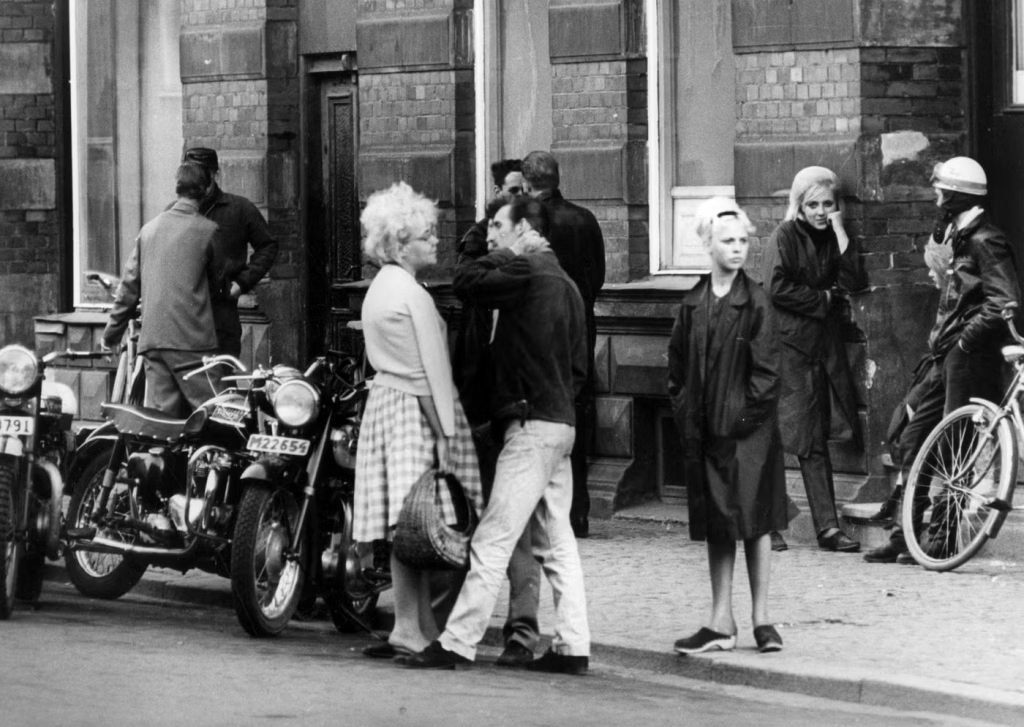
Frasses Bar - where Triumphs and BSAs made some noice
FRASSES BAR
Malmö’s legendary knuttefik – where motorcycles, rock’n’roll and Coca-Cola ruled the night
There are restaurants and cafés that serve food. There are bars that serve drinks. And then there are places that become part of a city’s mythology.
Frasses Bar in Malmö was one of those places.
For a generation of young Malmö residents, the name Frasses was enough to conjure up a very particular picture: motorcycles parked outside, leather jackets, jukebox music, Coca-Cola, sausages, laughter and a crowd of young people who seemed to have discovered a new kind of freedom.
Located at the corner of Spångatan and Skolgatan, close to Möllevången, Frasses became Malmö’s legendary knuttefik – a meeting place for the motorised youth of the late 1950s and 1960s.
And while stories about the place sometimes stretch back into the 1940s, the historical record is clear: Frasses Bar opened on 15 March 1957. Frasse and his family quickly turned the little bar into one of the city’s best-known gathering places for raggare, knuttar and spättor – the colourful vocabulary of Sweden’s emerging motor youth culture.
A very special opening day
According to Malmö heritage material, the first customer through the door on opening day was a man named Neman, who operated a furniture-upholstery workshop at Spångatan 15.
It sounds almost too ordinary for the beginning of such a legendary establishment.
But that is how urban legends usually begin. No brass band. No celebrity ribbon-cutting. Just a local customer walking through the door – followed by thousands of stories over the years.
Frasses soon became something considerably more interesting than an ordinary neighbourhood café.
Welcome to the world of the knuttar
The 1950s were changing Sweden.
The war years were over. Young people had more money, more leisure and an increasing desire to create an identity separate from their parents. American cars, rock’n’roll, leather jackets and motorcycles became symbols of independence.
The motorcycle was particularly powerful.
It meant mobility. It meant adventure. And, perhaps most importantly, it meant that you could simply get on and leave.
At Frasses, that culture found a home.
Photographs from the period show groups of bikers gathered around their machines outside the bar. Among the motorcycles documented in historical material are BMW R60s, Triumph T110s and a BSA Golden Flash. Some of the riders are remembered by wonderfully Swedish nicknames: Jan “Mjuk” Persson, “Triumph-Arne”, “Snoddas” from Landskrona, Nisse Frohm from Helsingborg, Bosse “Sme” from Bjuv and “Silla” Börje from Helsingborg.
The names alone sound like characters from a Swedish biker movie.
More than a café
Frasses was never just about motorcycles.
Inside was another essential ingredient of 1950s and 1960s youth culture: the jukebox.
The combination was irresistible – food, Coca-Cola, music and people.
The jukebox could transform a simple evening into an event. Rock’n’roll was still considered dangerously modern by some parents, while to the young crowd it was simply the soundtrack of a new life.
Frasses became a place where people could meet, flirt, boast, argue, laugh and show off their latest motorcycle.
And, naturally, discuss which motorcycle was fastest.
That particular argument has probably never been settled.
The Frasses reputation
To outsiders, however, Frasses could appear rather intimidating.
One charming recollection from a Malmö childhood illustrates just how powerful the reputation had become.
In December 1960, a family car carrying a group of children passed Frasses during a police driving-licence inspection. The father was stopped and discovered that he did not have his driving licence with him.
The police allowed him to go home and retrieve it.
The children, however, had to remain behind as security.
Their destination for this unexpected waiting period?
Outside Frasses.
The children reportedly watched the famous café with considerable apprehension. They knew that this was Frasses Bar – the legendary place associated with Malmö’s bikers.
Of course, nothing happened.
But the story is priceless because it demonstrates the reputation Frasses had acquired. To a child in 1960, the place could sound almost mythical – somewhere populated by mysterious bikers who looked as though they belonged to another world.
In reality, it was a café.
But legends rarely bother with reality.
The motorcycles of Malmö
Frasses was also part of a much broader motorcycle culture developing throughout southern Sweden.
The Malmö branch of the Frivilliga Motorcykelkåren, FMCK, was formed in 1958, just one year after Frasses opened. Historical material from FMCK Malmö includes photographs of the Frasses crowd and describes the establishment as Malmö’s knuttefik.
The photograph is particularly evocative.
There are the motorcycles, of course. But look beyond the machines and you see something else: friendship.
These young people had found their tribe.
Some came from Malmö. Others travelled in from Landskrona, Helsingborg, Bjuv and other parts of north-western Skåne. Frasses was a destination as much as a café.
Kal P Dal puts it into music
If Frasses was part of Malmö’s biker folklore, it eventually became part of Malmö’s musical folklore too.
Local rock’n’roll legend Kal P Dal immortalised the atmosphere in his song “Raka rör”.
The song’s world is one of Saturday nights, motorcycles, American cars, rock’n’roll, dancing and youthful energy – and Frasses appears right in the middle of it.
That is perhaps the ultimate compliment for a Malmö institution.
A place can disappear physically.
A song can keep it alive.
The golden years
The late 1950s and 1960s were Frasses’ great era.
Malmö itself was changing rapidly. The city was still strongly industrial and working-class, but television, American popular culture, new music and new fashions were reshaping everyday life.
Young Malmö residents wanted somewhere to go.
Frasses provided it.
There was no need for a sophisticated concept, celebrity chef or expensive interior design.
The recipe was remarkably simple:
Motorcycles outside.
Friends inside.
Music from the jukebox.
Something to eat.
A Coca-Cola in your hand.
And absolutely no reason to go home yet.
And then the world moved on
But every legendary meeting place eventually faces the same enemy:
time.
The generation that had made Frasses famous grew older. Youth culture changed. New clubs and meeting places appeared. Music evolved. Cars became increasingly important to the raggare scene, and the old motorcycle café culture gradually lost its central position.
Frasses could not remain permanently frozen in 1960.
Its decline was therefore not necessarily a dramatic collapse. It was something more familiar – a gradual fading of the world that had created it.
The jukebox became quieter.
The motorcycles moved elsewhere.
The young people became adults.
And eventually, Frasses Bar became history.
But Malmö remembered
Today, the physical Frasses is gone, but its memory has proved remarkably durable.
Malmö’s heritage organisations still describe it as one of the city’s most legendary sausage bars. Historical photographs preserve the bikers and their motorcycles. Malmö Museum has even preserved a painting depicting the Frasses corner at Spångatan and Skolgatan, complete with the characteristic yellow sign with red lettering.
And then there are the stories.
The nicknames.
The motorcycles.
The jukebox.
The Coca-Cola.
The police checks.
The nervous children waiting outside.
The Saturday nights.
The music.
And the feeling that something exciting was happening just around the corner.
The last roar
Imagine Malmö on a Saturday night around 1960.
A Triumph fires up outside.
Someone revs a BMW.
Another rider claims his machine is faster.
Nobody believes him.
Inside Frasses, the jukebox starts another record. Someone orders a Coca-Cola. Friends laugh. A couple disappears onto the dance floor. Outside, motorcycles line the pavement.
The city continues around them.
But for a few hours, this little corner of Spångatan and Skolgatan belongs to the young.
That is why Frasses Bar deserves its place in Malmö history.
It was never the city’s grandest restaurant. It did not have white tablecloths, chandeliers or famous chefs.
It had something far more valuable:
character.
Frasses gave a generation somewhere to meet, somewhere to belong and somewhere to dream about the open road.
The engines eventually fell silent.
The jukebox stopped.
The young bikers grew old.
But in Malmö’s collective memory, Frasses Bar is still open.
All you need to do is listen carefully.
You might just hear a motorcycle starting outside.