
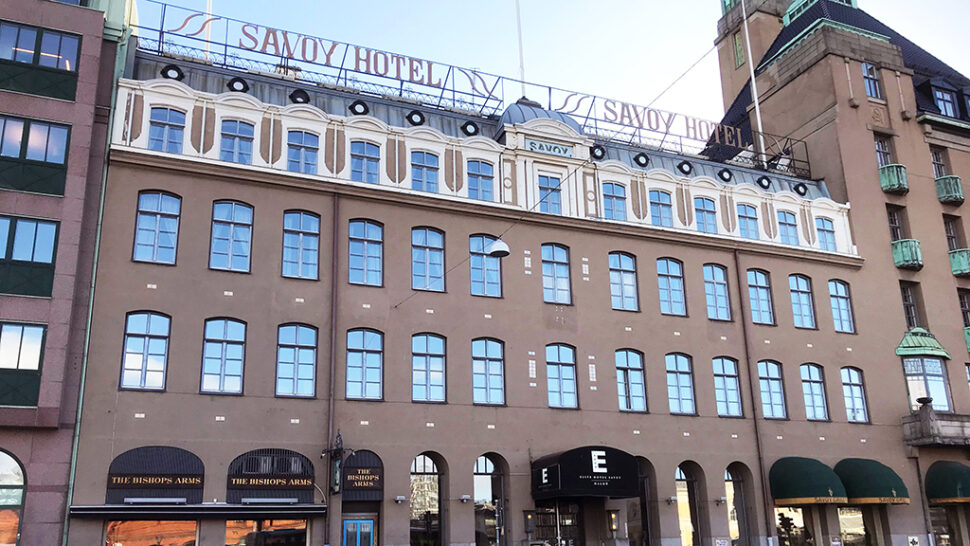
Savoy hotel - international guests and legendary detectives
SAVOY HOTEL, MALMÖ
Where royalty, revolutionaries, artists, writers and fictional murderers met
A hotel with stories in the walls
Across from Malmö Central Station stands a hotel with an unusually crowded guestbook – not merely with names, but with stories. Savoy has been a meeting place for travellers, businessmen, artists, politicians, writers and characters who exist only on the printed page.
The address has been associated with hospitality since medieval times. A guesthouse called Strandgården once stood here; in 1862 a more substantial hotel, Hotel Svea, was built on the site. It later became Hotel Horn before taking the name Savoy in 1902 – a name chosen to evoke the international elegance of London’s famous Savoy.
For more than a century, the hotel has watched Malmö arrive, depart, celebrate, argue, fall in love and occasionally make history.
From Hotel Svea to Savoy
The transformation into Savoy coincided with Malmö’s growing confidence as an international commercial city. The location was perfect: directly opposite the railway station and close to the harbour, making it a natural first stop for visitors arriving in town.
Then came the Baltic Exhibition of 1914. In preparation, the hotel was substantially remodelled by architect Frans Ekelund. A magnificent dining room and banquet facilities were added, together with additional rooms.
Suddenly Savoy was not merely somewhere to sleep. It was somewhere to be seen.
Under the chandeliers, Malmö’s business elite, visiting dignitaries and cultural figures could dine and celebrate. The restaurant became an institution in its own right – and, over the decades, a stage on which some extraordinary characters would appear.
When Lenin stopped for lunch
Few hotel anecdotes can compete with this one.
In April 1917, Vladimir Lenin passed through Malmö on his journey from exile in Switzerland towards revolutionary Russia. Before continuing by train to Stockholm, Lenin and his companions went to the Savoy for a Swedish smörgåsbord.
The menu sounds almost comically luxurious when compared with the urgency of Lenin’s journey: salmon, rye bread, ham, smoked game, pickles, pike-perch, cheese, sour cream and substantial quantities of caviar have all been described in accounts of the meal.
Most of Lenin’s companions apparently attacked the buffet with enthusiasm. Lenin himself was more preoccupied with political developments in Petrograd.
It is difficult to imagine a more Malmö scene: one of the twentieth century’s most consequential revolutionaries stopping at a grand hotel opposite the railway station to eat Swedish buffet food before catching his train.
There is even a later anecdote about visitors asking whether “Lenin” left a souvenir at Savoy – only to be jokingly misunderstood as asking about “Lennon”. At Savoy, apparently, even history occasionally needs subtitles.
The international stars arrive
Over the decades, Savoy attracted an extraordinary roll call of international personalities. The hotel itself lists such celebrated guests as Hollywood and entertainment stars Judy Garland and Sammy Davis Jr, alongside Lenin.
Other accounts of the hotel’s illustrious guest history also associate Savoy with names such as Marlene Dietrich. The important point is not simply that famous people slept there. It is that Savoy occupied a position where international touring, entertainment, politics and Malmö’s own cultural life constantly crossed paths.
A star arriving at Malmö Central could be at Savoy within minutes.
For a provincial city that was increasingly becoming an international crossroads, that mattered.
And there was another advantage: a famous guest could arrive, dine, disappear upstairs and continue travelling without necessarily turning the entire city upside down. Well, at least that was the theory.
Enter Piraten
Among all the personalities associated with Savoy, one of the most entertaining was not an international superstar at all.
He was one of Skåne’s greatest storytellers: Fritiof Nilsson Piraten.
The author, lawyer and legendary raconteur was deeply connected with the world of restaurants, food, drink and human eccentricity. His writing transformed ordinary people into unforgettable characters, often with a mischievous exaggeration that made fact and fiction wonderfully difficult to separate.
At Savoy, Piraten had something normally reserved for royalty and very important regulars: his own table.
For many years, he had a permanent table in the restaurant, a place where friends and acquaintances knew they might find him. The hotel’s history also remembers composer and television personality Sten Broman as another famous regular with his own table.
Piraten’s connection with the hotel reaches further back into its history. Before it was Savoy, the establishment was Hotel Horn – and Piraten immortalised the hotel’s lavish smörgåsbord in his novel Bock i örtagård.
His descriptions of the food are gloriously excessive: herring, cheeses, cold cuts, sausages, meatballs and an impressive parade of delicacies, accompanied by a silver aquavit dispenser that sounds as though it might have required its own waiter.
It is exactly the kind of scene Piraten loved.
And one suspects that if anyone had complained about the size of the meal, Piraten would simply have ordered another course and turned the complaint into a story.
A restaurant made for characters
Savoy’s restaurant developed a personality of its own. Regulars became institutions. Tables acquired reputations. Waiters knew who wanted what before the order had been completed.
The great attraction was the mixture.
A businessman might be seated close to an author. A musician could be sharing the room with a politician. A touring performer might be having dinner a few tables away from one of Malmö’s best-known local characters.
In later recollections, the old dining room is remembered with white tablecloths, formal service and an atmosphere that encouraged long lunches and even longer stories.
This was not fast food.
A meal could become an afternoon. An afternoon could become an evening. And an evening could become something nobody quite remembered the next morning – except, perhaps, the waiter.
The rise, the long decline and reinvention
Savoy’s great age was built on the importance of the grand city hotel. Before international chains and anonymous business hotels, a prestigious hotel was part railway station, social club, restaurant, meeting room and local theatre.
But that world changed.
Travel became more efficient. International hotel groups expanded. Dining habits became less formal. The grand dining room lost some of its central role, while new restaurants and entertainment venues competed for Malmö’s attention.
Savoy experienced its own periods of change, with different restaurant concepts and operators appearing over the years. At times, the old institution seemed to belong more to memory than to contemporary Malmö.
Yet the hotel itself survived.
In 1983 it was acquired by the company that developed into Elite Hotels of Sweden, and the Savoy name remained firmly attached to the building. The strategy of preserving historic city hotels rather than replacing them with generic modern properties helped keep places such as Savoy alive.
And that may be Savoy’s greatest victory: not remaining unchanged, but changing without losing its identity.
Murder at the Savoy
Then came the murder.
Not a real one – although for generations of crime-fiction readers, it feels remarkably real.
Maj Sjöwall and Per Wahlöö’s 1970 novel Polis, polis, potatismos! – published in English as Murder at the Savoy – begins with the assassination of a powerful industrialist at the Hotel Savoy in Malmö.
It is the sixth novel in the celebrated Martin Beck series, and unlike most of the books in the series, Malmö is not merely a passing location. The city is central to the story.
The fictional murder takes place in the restaurant during the summer of 1969. Martin Beck and his colleagues are drawn into a case involving industrial power, politics, social tensions and the darker side of Swedish society.
The choice of Savoy was inspired.
What better place for a murder than a hotel where history, wealth, celebrities and ordinary travellers have been crossing paths for generations?
The novel transformed the restaurant into one of Swedish crime fiction’s most recognisable locations.
For readers, every elegant dining room suddenly had a suspicious waiter, every businessman might have a secret and every table could potentially conceal a motive.
The real Savoy versus the fictional one
There is something deliciously appropriate about the fact that Savoy became the scene of a fictional assassination.
Real life had already supplied enough drama.
Lenin had eaten there on his way to revolution. International stars had stayed there. Piraten had held court at his table. Sten Broman had his own corner of the restaurant. Business deals had been made, romances had begun and countless Malmö stories had unfolded under the chandeliers.
Sjöwall and Wahlöö simply added a corpse.
The authors also knew Malmö intimately. They lived in the city and used its streets, institutions and social contrasts as material. Malmö City notes that Polis, polis, potatismos! is the only Martin Beck novel to be set substantially in Malmö.
The result is a fascinating overlap between literary Malmö and real Malmö: readers can stand outside the same hotel and imagine Martin Beck arriving to investigate a crime that never happened.
If the walls could talk
Today, Savoy remains one of Malmö’s historic meeting places, still standing opposite the railway station where so many of its stories began.
Its past is almost absurdly rich.
Medieval travellers.
Railway passengers.
Baltic Exhibition visitors.
Lenin.
Judy Garland.
Sammy Davis Jr.
Piraten.
Sten Broman.
And, courtesy of Sjöwall and Wahlöö, Martin Beck.
The real magic of Savoy, however, lies in the fact that the famous names are only a fraction of the story. Thousands of ordinary guests have sat at its tables. Waiters have carried thousands of plates. Musicians have played. Businessmen have negotiated. Lovers have met. Friends have stayed too long over dinner.
The celebrities supplied the headlines.
The ordinary people supplied the atmosphere.
And somewhere, perhaps, Piraten’s ghost is still sitting at his table, listening to the conversation and quietly preparing the punchline to a story that nobody else has heard yet.
The last word belongs to Savoy
Hotels are unusual witnesses. They see people at their most public and, sometimes, at their most private.
Savoy has witnessed more than a century of Malmö life from the best possible position: right beside the railway station, with the city arriving at its front door.
Its fortunes have risen and fallen. Its restaurant has changed. Its clientele has changed. Malmö has changed.
But the stories remain.
That is why Savoy is more than a hotel.
It is a piece of Malmö’s cultural memory – part grand hotel, part restaurant, part stage, part literary landmark.
And perhaps that is why the old expression still feels right:
See you at Savoy.
Editorial research note: Savoy’s own current history confirms its medieval roots, 1862 Hotel Svea origins, 1902 Savoy name, 1914 expansion, notable guests including Judy Garland and Sammy Davis Jr., and regular tables associated with Fritiof Nilsson Piraten and Sten Broman. Malmö City and publishing sources confirm the Martin Beck novel’s Malmö setting and the murder at Hotel Savoy.