
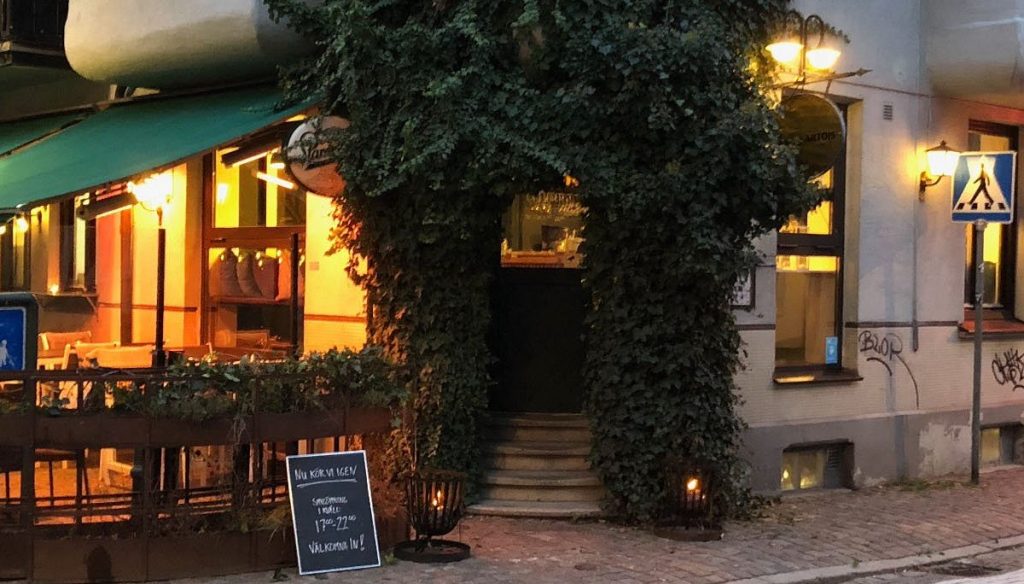
Café Siesta - legendary hotspot for Malmö's cultural celebrities
THE LAST COFFEE IS NEVER JUST COFFEE
Café Siesta, Gamla Väster, and the art of watching Malmö watch itself
An editorial on the rise, reinvention and enduring mythology of one of Malmö’s most storied little corners.
A small stage with very good coffee
Every city has a place where its public life loosens its tie. In Malmö, for generations of artists, musicians, writers, actors and professional observers of other people’s business, that place has been Siesta on Hjorttackegatan, in Gamla Väster. It is a small corner with an outsized reputation: part neighbourhood watering hole, part unofficial green room, part social weather station.
At Siesta, the coffee is never the whole point. The real menu has always included familiar faces, unfinished arguments, old grudges that have ripened into jokes, and the delicious possibility that the person at the next table has just come from a rehearsal, a gallery opening, or a gig that went either brilliantly or disastrously. In Malmö, those two outcomes are often separated by only one more round.
The legend begins with the regulars
Siesta’s exact founding story is less securely documented than its mythology. What is clear is that the place had become a fixture by the 1980s, and that it has been part of Gamla Väster’s café-and-krog landscape for decades. A 2010 local blog noticed the sign’s distinctly old-school look and joked that Siesta seemed to have been there since the Danes marched across the Sound. History may be less precise; the feeling is not.
By the late 2000s, the place was already being described as one of Malmö’s long-lived social refuges. A 2009 review praised its unpretentious menu and lively room; a 2010 account remembered the old familiar faces and the terrace as a natural meeting point. Siesta was not trying to be the newest thing in town. That was precisely its charm. Trends arrived, posed for a photograph, and left. Siesta stayed put.
And then there is the music. Malmö band Wilmer X helped lodge Siesta in the city’s popular memory, while the café’s wider orbit became part of the lore of local creative life. The venue’s reputation travelled the way the best reputations do: not through a marketing campaign, but by word of mouth, late-night retellings and the phrase, ‘You should have been there.’
The Malmö safari
People-watching at Siesta is a local art form. The novice scans the room for someone famous. The seasoned regular does not scan at all; they pretend to be studying the menu while conducting a forensic investigation with their peripheral vision.
Here, a musician can look like a man who has come to repair a bicycle. A painter may be mistaken for someone waiting for a plumber. A celebrated cultural figure might sit quietly enough to be overlooked—until three people independently find reasons to walk past the same table. Malmö is not Stockholm: celebrity often arrives without a velvet rope, and may be wearing yesterday’s coat.
The most reliable game is not ‘Who is that?’ but ‘How many people are pretending not to know who that is?’ At a place like Siesta, recognition is a delicate transaction. You don’t want to gush. You don’t want to stare. You want to demonstrate that you know, while making it clear that you are far too Malmö to care. This is a difficult performance, and the coffee gives you something to do with your hands.
Imagine the classic Siesta exchange: one regular asks another what they are working on. ‘A little project,’ comes the reply. In cultural Malmö, ‘a little project’ might mean a novel, a record, a theatre production, or a three-year disagreement with a funding committee. No one asks for a progress report. They order another coffee. This is a comic, composite scene rather than a documented quotation—but anyone who has spent time around artists will recognise the genre.
The rise: when a café becomes an institution
Siesta’s success was never simply about being fashionable. It offered something more durable: a room where people could return without having to explain themselves. You could arrive with a triumph, a rejection, a hangover, a new idea or no idea at all. The place would supply the setting; the regulars would supply the commentary.
Gamla Väster helped. Its old streets and intimate scale make it feel like a neighbourhood that has resisted the city’s urge to polish every surface. The district’s survival was not inevitable: during the 1970s, plans for major changes threatened parts of its historic fabric, and local preservation efforts helped protect the area’s character. The cafés and small restaurants that now feel timeless depend, in part, on the fact that the neighbourhood was not entirely remade.
Siesta also belongs to a grand Scandinavian tradition: the establishment that is neither quite a café nor quite a restaurant, neither a private club nor a public square. It is a place where the boundaries blur. A lunch can become an afternoon; an afternoon can become a meeting; a meeting can become a story told for the next ten years. The bill, meanwhile, is the one part of the story everyone would prefer to forget.
The fall—or the long, slow costume change
Every legend eventually meets the terrifying question: what happens when the world changes? The old café culture depended on time that was allowed to drift. The modern city runs on bookings, notifications, branded experiences and people announcing that they have to leave in seven minutes. A place built on lingering can look almost subversive in such a world.
Siesta has changed, too. Food, ownership, expectations and the surrounding city do not stand still. The current restaurant describes itself as a modern neighbourhood restaurant, and says Nikola and Samantha have run it since 2018, with a focus on seasonal ingredients and a warm, personal atmosphere. That is not the end of the story; it is the latest chapter. The old haunt and the present-day restaurant occupy the same address, but every generation brings its own idea of what Siesta ought to be.
The decline of a legendary café is rarely a single dramatic closing scene. More often, it is a gradual change in the cast. One regular stops coming. Another moves away. The musician who once played three nights a week now has a day job. The young artist becomes the older artist who complains that the young artists have no respect for tradition. Eventually, someone says, ‘It isn’t what it used to be.’ This sentence is the unofficial national anthem of every cultural institution that has survived long enough to be loved.
The last word belongs to the corner
So is Siesta still a place to spot Malmö’s cultural elite? It can be—but no café can guarantee a celebrity appearance, and the best reason to go is not to collect sightings. It is to experience a little of the city’s social life at human speed. Sit down. Listen without eavesdropping too obviously. Notice who greets whom, who gets waved over, who is deep in conversation and who has perfected the art of looking busy while doing absolutely nothing.
Siesta’s rise was the rise of a meeting place into a local institution. Its fall, if that is the word, is the fading of the old promise that a café could hold an entire cultural scene in one room. Yet the promise has not vanished. It has merely become harder to find in a world that rarely sits still.
Perhaps that is why the legend endures. A famous person may be at the next table—or nobody famous at all. Either way, a good café makes the ordinary feel like it might become a story. In Malmö, that is a respectable form of magic. And at Siesta, the coffee was never just coffee.