
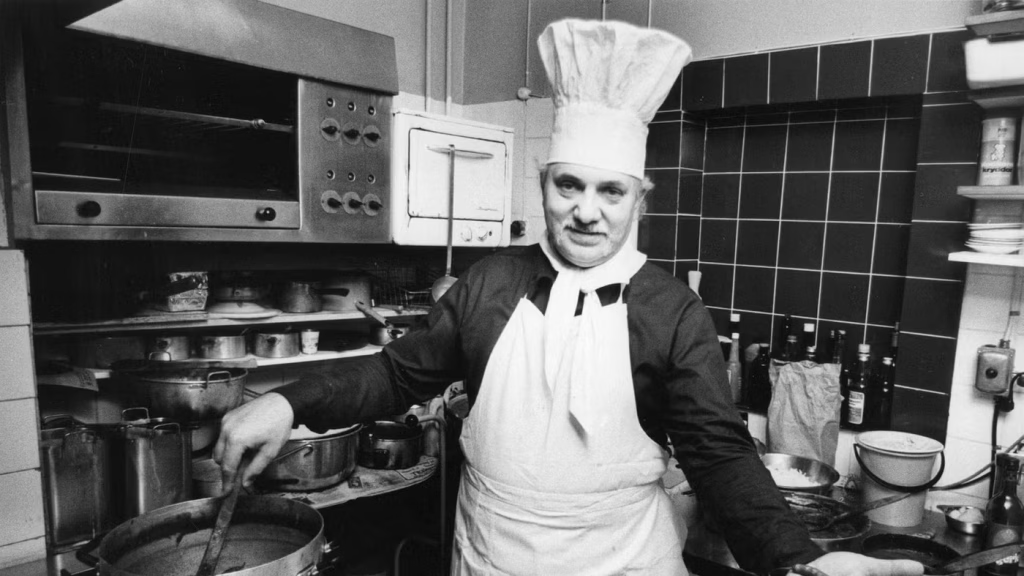
Hungaria - being served Zoltan's special hospitality
HUNGARIA
The legendary Malmö restaurant everybody called Zoltans
At Davidshallsgatan 3 stood a Hungarian restaurant that became one of Malmö’s most unlikely cultural institutions. Officially it was Restaurang Hungaria. Nobody cared. Everybody called it Zoltans. Its menu became shorter, its wine increasingly mysterious and its proprietor more theatrical with every passing year. For generations of Malmö artists, musicians, bohemians, students and ordinary hungry citizens, Zoltans was less a restaurant than a small piece of living theatre.
There are restaurants that become famous because of their food.
There are restaurants that become famous because of their chef.
And then there was Hungaria.
Hungaria became famous because of Zoltan.
For decades, the Hungarian-born proprietor presided over his restaurant on Davidshallsgatan with a mixture of hospitality, stubbornness and theatrical eccentricity that made him one of those Malmö characters people continued talking about long after the last plate had been cleared.
The restaurant opened in 1958, two years after Zoltan arrived in Malmö in the aftermath of the Soviet invasion of Hungary. According to recollections published by Malmö historian and writer Stephan Skougaard, Zoltan was born in 1918 in Transylvania and walked with a limp, using a crutch as he moved between the tables.
The address was Davidshallsgatan 3.
The name on the door was Hungaria.
But ask a taxi driver where Zoltans was and there was no confusion.
“Take me to Hungaria”
One of the enduring stories about the restaurant concerns precisely that distinction.
A customer once asked a Malmö taxi driver to take him to Restaurang Hungaria. The driver apparently had no idea where it was. When the customer changed the instruction to “Zoltans”, the problem disappeared.
That tells you almost everything.
Hungaria was the official name. Zoltans was the institution.
The restaurant attracted a wonderfully mixed clientele: ordinary Malmö residents, artists, musicians, cultural figures, students and people associated with the city’s progressive and bohemian circles. It was the sort of place where social boundaries became considerably less important after a few beers.
Inside were heavy, dark wooden tables whose surfaces had accumulated years of scratches, stains and candle wax. Chianti bottles served as candleholders, and the atmosphere was informal enough that nobody seemed particularly interested in whether the place looked fashionable.
It didn’t need to.
Zoltan was the attraction.
The restaurant with a very short menu
The Hungaria of its later years developed one of Malmö’s great restaurant legends: a menu that existed largely to create the impression that there was a menu.
At one stage the offering had been reduced to a handful of dependable dishes. Among the surviving classics were a sausage platter, stuffed bell peppers and goulash soup, with other Hungarian dishes occasionally appearing on the printed or displayed menu.
The practical problem was that almost everything was usually unavailable.
A customer could study the menu, choose something with confidence and then hear the inevitable verdict.
Sold out.
Stuffed peppers?
Sold out.
Hungarian steak?
Sold out.
Soup?
Sold out.
Eventually, after the ritual had been completed, Zoltan would arrive at the same conclusion.
Goulash.
There was always goulash.
A contemporary recollection describes the routine beautifully: Zoltan would announce that various dishes were finished before suggesting goulash, often accompanied by a Gösser beer or a bottle of Egri wine. Once the order was placed, he demanded payment in advance before theatrically announcing the order to the kitchen.
Then came the extraordinary part.
Zoltan would disappear into the kitchen, return in another voice and effectively play both chef and waiter. Sometimes he even appeared to argue with an imaginary member of staff.
It was restaurant service as one-man theatre.
And somehow the goulash was remembered as excellent.
The soup that saved the evening
The goulash soup became more than a dish. It became a survival strategy.
If you entered Hungaria hungry, the answer was simple: eventually, you would be eating goulash.
There was something wonderfully democratic about it. The menu might promise fifteen possibilities, but reality offered one.
You could spend ten minutes negotiating with Zoltan or simply surrender immediately.
The experienced customers knew better.
They ordered the goulash.
The stories of the restaurant consistently emphasise the same combination of limited food, inexpensive drink and unforgettable atmosphere. Jacques Werup also wrote about Zoltan in Hemstaden, recalling a proprietor who would disappear into the kitchen to produce the goulash himself when customers asked what was available.
In other words, the shortage was not necessarily the problem.
It was part of the show.
And then there was the artist wine
If the goulash was legendary, “konstnärsvinet” – the artist wine – was notorious.
The concept was brutally simple.
Leftover wine from previous guests was collected and poured together into bottles. The resulting mixture was sold as artist wine, particularly to the bohemian and artistic crowd who gathered around Malmö’s galleries and cultural life.
One later recollection describes the wine as containing slops and spills, with the occasional cigarette butt apparently turning up in the bottle. The writer recalls vernissage celebrations ending at Hungaria, where artists and gallery-goers would continue the evening over Zoltan’s peculiar vintage.
The story was repeated elsewhere in accounts of Malmö’s cultural life, including references to Werup’s Hemstaden.
Whether every legendary detail happened exactly as remembered is impossible to establish.
But that is almost beside the point.
“Artist wine” became part of the mythology of Zoltans because it perfectly captured the place: improvised, slightly outrageous, inexpensive and completely unconcerned with conventional restaurant etiquette.
Zoltan versus closing time
If the menu was theatre, closing time was performance art.
As the clock approached the early hours, Zoltan would eventually stand in the middle of the restaurant and shout:
“Gå him!”
Go home.
The customers, naturally, found this hilarious.
So they stayed.
According to Skougaard’s recollection, the situation became something of a competition between Zoltan and his guests. The more they refused to leave, the more elaborate his attempts became. On one occasion he allegedly telephoned the police, pretending to report that guests would not go home, then crouched behind the counter and imitated a police siren himself.
On another occasion, he reportedly blew out the candles, switched off the lights, put on his coat and locked the restaurant from outside as though he had simply gone home.
The guests were left sitting in darkness.
Eventually Zoltan returned, furious.
“Gå him!”
The guests stayed.
This was not conventional customer service.
It was Zoltan service.
The characters around the tables
What made Hungaria special was not simply Zoltan’s behaviour but the people who gathered around him.
The restaurant became part of Malmö’s artistic and cultural ecosystem. Vernissages could continue there after galleries closed. Artists, writers, musicians and other cultural personalities mingled with ordinary Malmö residents.
The combination was important.
A restaurant like Hungaria could not have been manufactured by a marketing department. Its atmosphere came from people who had discovered the place and then, over time, made it their own.
The worn wooden tables became witnesses to generations of conversations.
The candles burned down.
The wine was poured.
The goulash appeared.
And somebody inevitably refused to go home.
The fall of Hungaria
Eventually, however, the world around Hungaria changed.
The building’s economics changed too. According to the surviving account of the restaurant, Zoltan faced a substantial rent increase and ultimately lost his tenancy. He protested by covering the windows with angry notices about Malmö bureaucracy and conspiracies, but the decision stood. The premises were eventually converted into a residence.
In 1984, the last goulash was served.
For Zoltan, the restaurant chapter was over.
For Malmö, an era had ended.
The Hungaria story could easily have stopped there. Instead, it took a completely unexpected turn.
The artist behind the restaurateur
The great revelation, at least to some of Zoltan’s former customers, was that the eccentric restaurateur had another life.
After leaving Davidshallsgatan, Zoltan moved to Marieholm, where he opened Hungaria Galleri and devoted himself increasingly to art and writing. According to Skougaard’s account, he wrote close to twenty books, including poetry collections, and worked as an artist, sculptor, painter and author.
The man who had appeared to be playing games behind the counter had apparently been doing something rather more complicated.
Perhaps the restaurant itself had been another form of performance.
The theatrical orders, imaginary staff, arguments with customers and mysterious wine were not necessarily evidence of incompetence. They may have been expressions of a personality that simply refused to operate according to ordinary rules.
And perhaps that is why people remembered him so fondly.
More than a restaurant
Today, the Hungaria name may mean very little to someone walking down Davidshallsgatan.
There is no menu promising stuffed peppers.
No bottle of artist wine.
No Zoltan emerging from the kitchen announcing that the goulash is ready.
But for those who remember Malmö before every neighbourhood had carefully designed restaurants, Instagram accounts and menus translated into three languages, Zoltans represents something almost impossible to recreate.
It was imperfect.
It was eccentric.
It could be frustrating.
It was also genuine.
The food might have been limited to sausage, stuffed peppers and goulash. The artist wine might have been a questionable exercise in recycling. The proprietor might shout at you to go home and then welcome you back the following evening.
Yet people returned.
They returned because Hungaria was not simply somewhere to eat. It was somewhere to be.
And Zoltan was not merely the owner.
He was the reason the place became a legend.
In the end, perhaps the greatest tribute came from the customers themselves. They could have gone anywhere in Malmö for a meal or a drink. Instead, they chose the little Hungarian restaurant on Davidshallsgatan where the menu was mostly sold out, the wine had a mysterious past and the proprietor might personally play the entire kitchen staff.
And if you stayed too long, you already knew what was coming.
“Gå him!”
Go home.
But come back tomorrow.