
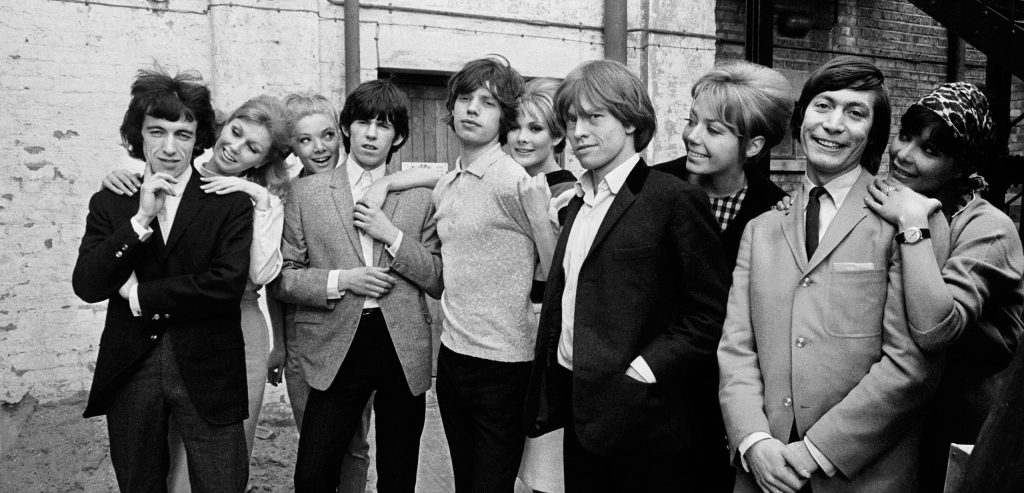
Klubb Bongo - Malmö's first rock club and some Stones
KLUBB BONGO
When Malmö discovered rock’n’roll – and refused to sit still
Before Malmö became famous for musical exports, clubs, festivals and a reputation for doing things its own way, there was a basement, a dance floor and two young men with an idea. Their name was Klubb Bongo.
There are clubs that come and go.
And then there are clubs that become part of a city’s DNA.
Klubb Bongo was one of those places.
For four remarkable years in the 1960s, Bongo transformed Malmö’s nightlife and helped turn the city into one of Sweden’s most exciting pop and rock towns. It was loud, youthful, occasionally chaotic and gloriously modern. Most importantly, it gave Malmö’s teenagers somewhere to go when the rest of society still wasn’t quite sure what to make of this new thing called pop music.
The story began on 29 February 1964, when Klubb Bongo opened at Ungdomens Hus on Skolgatan. Hundreds of young people reportedly crowded the pavement outside for the opening night. It was billed as Malmö’s first real twist club – and the reaction suggested that the city’s youth had been waiting for exactly this.
And they were only getting started.
Two young men and one big idea
The people behind Bongo were Dan Walterström and Per Falck, two young Malmö enthusiasts who had met during a summer holiday and somehow arrived at the rather ambitious conclusion that Malmö needed its own pop club.
They were right.
Bongo was initially housed at the old Ungdomens Hus on Skolgatan. But the popularity of the club quickly created a problem: there simply wasn’t enough room.
The solution came in 1966.
Bongo moved to Friisgatan 18, into the old concert premises known as Logen. The move meant more capacity, more possibilities and longer opening hours. Academic research into Malmö’s youth and cultural history confirms that the move was motivated partly by the limitations of the Skolgatan venue, which could accommodate roughly 300 people.
The new venue was ready.
Malmö’s teenagers were ready.
And then things got seriously interesting.
From twist to total mayhem
Bongo had started as a twist club, but the musical revolution was moving at frightening speed.
Within a few years, the programme was astonishing.
Local Malmö bands such as Gonks, Namelosers and Troublemakers shared the stage with Swedish favourites including Hep Stars, Tages, Slam Creepers and Shanes.
Then came the international names.
The Yardbirds. Small Faces. Ten Years After. John Mayall.
And one evening in particular became immortal.
Jimi Hendrix.
On 23 May 1967, the Jimi Hendrix Experience played at Bongo’s Friisgatan venue. Malmö had effectively invited one of the world’s most revolutionary guitarists into an old concert hall in the middle of town.
Hendrix played.
The audience loved it.
The local press?
Not quite so much.
The performance became legendary partly because it was enthusiastically received by the audience while receiving a distinctly less enthusiastic response from at least some of the local critics. Malmö City itself today identifies Hendrix’s Bongo appearance as one of the notable events in the history of Friisgatan.
It is almost wonderfully Swedish.
The kids thought Hendrix was fantastic. The newspaper wasn’t convinced.
History, as usual, sided with the kids.
The Bongo crowd
The real stars of Bongo weren’t only the artists.
They were the teenagers.
This was a generation discovering a new kind of freedom. Pop music wasn’t simply entertainment anymore. It was identity.
The clothes changed.
The hairstyles changed.
The dancing changed.
And, perhaps most importantly, the relationship between adults and young people was changing.
At Bongo you could meet aspiring musicians, schoolkids, fashion-conscious teenagers, future artists and people who simply wanted to dance until somebody told them it was time to go home.
There were probably parents who considered the whole thing a terrible idea.
Which, naturally, made it considerably more attractive.
The queue outside became part of the spectacle. Inside, the atmosphere could be electric. The club was somewhere between concert hall, dance floor and social laboratory.
And nobody had invented the phrase “content creator” yet.
Thank goodness.
The only thing you had to create was a good Saturday night.
When Malmö met the world
What made Bongo extraordinary was the combination of local and international music.
A young Malmö band could stand on the same stage as an internationally recognised act.
That mattered.
It meant local musicians could see what was happening elsewhere – and then go back to their rehearsal rooms and try to beat it.
The club helped give Malmö’s emerging music scene confidence.
According to Kira Förlag’s documentation of the club, Bongo became an important part of Malmö’s transformation into an innovative and tolerant music city, giving young local bands valuable stage experience alongside international acts.
That legacy shouldn’t be underestimated.
Long before Malmö became associated with bands such as The Cardigans and The Ark, the city was already building a reputation as a place where music could happen.
Bongo was one of the foundations.
The characters behind the curtain
Every legendary club has its personalities.
At Bongo, Dan Walterström and Per Falck were central figures from the beginning. Later accounts and research into the club also mention Bosse Johnsson as part of the group operating the venue.
But there were countless other characters – musicians, promoters, technicians, young fans and local personalities – who collectively created the atmosphere.
The beauty of Bongo’s story is that many of them weren’t famous at the time.
Some became musicians.
Some became journalists.
Some became businessmen.
Some simply grew old and occasionally told their grandchildren:
“You should have been there when Hendrix played.”
And somewhere in the family room, the grandchildren probably smiled politely.
They shouldn’t.
They really should have listened.
The funny thing about being legendary
There is always a slightly comic side to nostalgia.
Nobody remembers standing in an uncomfortable queue.
Nobody remembers the sticky floor.
Nobody remembers the toilets.
Nobody remembers how loud the music actually was.
Nobody remembers that somebody’s date probably disappeared with somebody else’s date.
Thirty or forty years later, everybody remembers that it was magical.
And perhaps that is precisely how it should be.
The surviving memories of Bongo have been collected extensively by journalist and author Ulf Clarén, whose 2022 book Bongo – berättelsen om Malmös första popklubb was based on interviews with the founders, performers and people who spent their teenage years at the club. The book is richly illustrated with photographs and memorabilia.
One particularly charming detail about Clarén himself?
He never actually got inside Bongo.
He was only thirteen when the club closed.
So he had to reconstruct the legend afterwards.
That may be the most Malmö thing imaginable: writing the definitive history of a club you were too young to enter.
The beginning of the end
Unfortunately, even the best parties eventually finish.
Klubb Bongo’s entire life lasted only about four years – 1964 to 1968.
The Friisgatan premises themselves were in a building destined for demolition. Malmö City notes that the building was a demolition property and that the house was ultimately torn down in 1968.
There was no grand, cinematic ending.
No final curtain with everybody holding hands.
Just the reality that buildings disappear, fashions change, economics intervene and young people eventually find somewhere else to go.
But by then, Bongo had already done its job.
It had changed Malmö.
Four years that lasted forever
Perhaps the most remarkable thing about Klubb Bongo is how much history it managed to pack into such a short existence.
Four years.
That’s barely enough time for a modern nightclub to redesign its logo.
Bongo managed to establish itself as Malmö’s first major pop club, nurture local bands, bring international stars to the city and give an entire generation a place to experience the cultural earthquake of the 1960s.
Its reputation became so strong that decades later, Wilmer X named an album “Klubb Bongo” – a rather beautiful indication that the club had passed from nightlife history into Malmö mythology.
The building is gone.
The queues are gone.
The guitars have fallen silent.
But Bongo remains.
It survives in photographs, in books, in old newspaper clippings and, most importantly, in the memories of the people who were there.
And perhaps you can still imagine it.
It is a Saturday night in 1967.
Malmö is buzzing.
A group of teenagers are hurrying down Friisgatan.
Someone is wearing an impossibly fashionable jacket.
Someone else has spent far too long getting their hair exactly right.
There is music coming from inside.
The queue is getting longer.
And somewhere backstage, a guitar is being plugged into an amplifier.
Nobody knows quite what is about to happen.
But they know it is going to be loud.
Welcome to Klubb Bongo.
Malmö’s first pop club.
Four years of music. A lifetime of memories.