
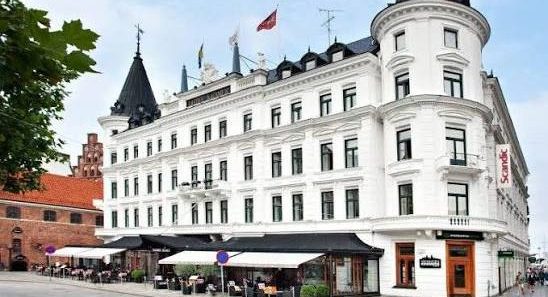
Kramer hotel - a legendary place for rendezvous and ghosts
HOTEL KRAMER, MALMÖ
The Grand Old Lady of Stortorget
A GO! editorial special on elegance, eccentric characters, celebrity encounters and the changing fortunes of one of Malmö’s most legendary hotels
A French château in the heart of Malmö
Stand in Malmö’s historic Stortorget and look towards Hotel Kramer. Its elegant façade, decorative details and distinctly continental character seem to belong to another age, when international travel was an adventure, a grand hotel was a statement of status, and the restaurant could be every bit as important as the guest rooms upstairs.
Hotel Kramer opened in the late nineteenth century, during a period when Malmö was rapidly developing into a modern commercial and industrial city. The railway had transformed travel, trade was flourishing, and an increasing number of international visitors were arriving in southern Sweden. The growing city needed somewhere appropriate to welcome them.
Enter Anna and Fritz Kramer, a German-born couple whose ambition was to create a hotel with a distinctly European atmosphere. The building that emerged was inspired by French château architecture, giving Malmö a touch of continental grandeur right beside its historic main square.
The hotel’s origins are usually dated to 1875–1878, reflecting the development of the business and its purpose-built premises. The building that still stands at Stortorget 7 dates from 1878, according to the hotel’s present-day operator, Scandic.
At a time when travel could be uncomfortable and unpredictable, a hotel like Kramer promised something reassuring: an elegant room, a good meal and the feeling that civilisation had caught up with you.
Anna Kramer: the woman behind the legend
Although the hotel carried the Kramer name, Anna Kramer deserves particular recognition. Following Fritz’s death in 1893, she continued running the business for almost three decades, establishing herself as a formidable businesswoman in an era when senior commercial roles were overwhelmingly occupied by men.
Anna was known for her firm management and close attention to the hotel’s finances. From her office on the upper floor, she helped maintain the establishment’s reputation while Malmö continued to grow around it.
There is an intriguing story attached to her memory. Local accounts claim that Anna’s presence never entirely left the building after her death. The hotel has long carried a ghostly legend involving its former owner, and stories about unusual happenings in historic buildings have always been irresistible conversation starters.
Whether Anna Kramer truly makes occasional inspections of her old establishment is a matter for individual belief. If she does, one hopes she remains satisfied with the housekeeping.
The more tangible legacy is impressive enough: Anna helped create an institution that survived changing generations, economic uncertainty and the transformation of the hotel business.
Where Malmö came to meet
Kramer was never merely a place to sleep. Its restaurant, bar and public rooms helped establish it as a meeting place for businesspeople, cultural personalities and Malmö residents who appreciated a little old-world atmosphere.
The restaurant culture of historic Malmö had its own unwritten rules. Certain tables acquired reputations, regulars developed their favourite seats, and a familiar face could become almost as much a part of the furniture as the polished woodwork.
A hotel restaurant offered a convenient meeting ground for people from different worlds. Travellers could encounter local personalities, artists could meet journalists, and business discussions could continue over dinner long after the offices had closed.
Kramer’s location made it particularly well suited to this role. Stortorget was at the heart of Malmö’s public life, surrounded by commerce, civic institutions and historic buildings. The hotel stood in the middle of the action rather than on its outskirts.
And then there was the food. In an age before every restaurant advertised itself through social media, a reputation was built through word of mouth. A memorable meal, an attentive waiter or an entertaining dinner companion could bring customers back for years.
The restaurant became part of the hotel’s identity—and the personalities who gathered there became part of its legend.
Sten Broman: music, manners and a table of his own
Few characters associated with Malmö’s restaurant culture were as unmistakable as Sten Broman.
Born in 1902, Broman was a Swedish composer, conductor, musicologist and influential music critic. He also became a celebrated radio and television personality, known for his formidable musical knowledge, flamboyant appearance, sharp tongue and theatrical manner.
Broman was not a man who seemed designed to disappear into a crowd. His distinctive clothing and cultivated eccentricity made him instantly recognisable, while his musical expertise earned him respect well beyond Skåne.
He could discuss the finer points of a composition with scholarly precision and then deliver an opinion with such confidence that anyone disagreeing might reasonably reconsider their position. His television appearances made him a familiar national figure, but Malmö remained central to his identity.
Hotel Kramer was among the establishments associated with Broman’s regular dining and social life. Accounts of the city’s old restaurant culture remember him as a familiar presence, with a preferred place at the table and the rituals that accompany a genuine regular.
There is, however, an important distinction in Malmö’s restaurant folklore: Broman is particularly well documented as having a regular table at Hotel Savoy, where he was associated with table number 16. His connections with Kramer belong to the wider story of his favourite Malmö haunts, and the precise details of a permanent table at Kramer are less firmly established.
That qualification does little to diminish the larger picture. Imagine Broman settling into a restaurant, his characteristic attire drawing glances from newcomers while old acquaintances greeted him as part of the evening’s expected entertainment.
One can picture a conversation beginning with music and moving rapidly into a passionate debate about culture, taste or the shortcomings of modern society. For Broman, dinner need not have been a quiet intermission between more important activities. It could be a performance in its own right.
In a city rich in colourful personalities, he was one of the most memorable.
Stars, performers and international connections
Kramer’s history belongs to the era when grand hotels were important meeting points for visiting performers, touring entertainers and cultural figures. Its international atmosphere was part of its original appeal, reflecting the growing connections between Malmö and the wider European world.
One name linked to the hotel’s history is Karl Gerhard, the celebrated Swedish revue artist and satirist. A local historical account recalls him at Kramer around the end of the Second World War, when he performed his anti-Nazi song Den ökända hästen från Troja. The episode evokes a time when entertainment could be political, and a hotel gathering could become part of the wider conversation about events unfolding across Europe.
It is worth being careful with celebrity lists, however. Many stories about famous visitors circulate around historic hotels, and an artist being associated with a venue does not automatically prove that they stayed overnight there. Reliable records identifying a definitive list of international stars who slept at Kramer are difficult to establish.
What can be said with confidence is that the hotel was built to welcome an increasingly international clientele and remained part of Malmö’s hospitality scene through generations of travel and cultural change. Its significance lies not only in the famous names that may have passed through its doors, but in the steady flow of visitors who made it a cosmopolitan meeting place.
And perhaps that is the more interesting story. A hotel’s history is rarely written exclusively by celebrities. It is also shaped by the touring musician arriving late, the traveller waiting for a train, the businessperson closing a deal over dinner and the local regular whose presence makes a restaurant feel like home.
The changing fortunes of a grand hotel
The rise of Hotel Kramer mirrored Malmö’s development. In the late nineteenth and early twentieth centuries, a grand hotel represented modernity, prosperity and international sophistication. Its architecture announced that Malmö was a city confident enough to welcome the world.
But the hotel business changed dramatically over the following century. Travel became faster, expectations shifted and new generations of hotels introduced different ideas about comfort, convenience and value. The grand dining rooms and elaborate rituals of nineteenth-century hospitality no longer defined every traveller’s ideal stay.
For Kramer, survival meant adapting without losing the character that made it distinctive.
Its fortunes changed alongside those of Malmö itself. Industrial expansion gave way to economic restructuring; transport and tourism evolved; and the city gradually reinvented itself as a centre for culture, education, business and international connections.
The old hotel was not immune to these changes. Its traditional image belonged to another era, and the market increasingly demanded contemporary facilities alongside historic charm. Yet Kramer’s central location and distinctive building offered something newer hotels could not easily reproduce: a genuine connection with the city’s past.
Rather than disappearing, the property entered a new chapter under modern hotel management. Today it operates as Scandic Kramer, retaining the historic building while offering contemporary accommodation and hospitality.
The old-fashioned grand hotel has not vanished. It has learned to live in the modern world.
A landmark that still has stories to tell
Hotel Kramer’s greatest achievement may be its survival. The building has witnessed the transformation of Malmö from a nineteenth-century commercial city into a modern international centre. It has welcomed generations of travellers, served as a restaurant and meeting place, and become associated with personalities whose stories still animate local history.
The legends of Anna Kramer and Sten Broman offer two very different portraits of its character: the determined businesswoman who built a lasting institution, and the flamboyant cultural figure whose presence could turn an ordinary dinner into an occasion.
Their stories remind us that historic hotels are not simply collections of rooms. They are stages on which private lives and public history briefly intersect.
Today, the façade still looks out across Stortorget, a reminder of a time when elegance was expressed in architecture, service and the art of making a guest feel welcome.
Hotel Kramer has experienced changing fashions, changing owners and changing expectations. Its original world may have faded, but the building remains.
And somewhere in its long history, one can imagine Sten Broman settling into his chair, preparing to deliver a verdict on the evening’s music, the food or the state of civilisation itself.
At Hotel Kramer, even the ordinary business of checking in has always had the potential to become part of a much bigger story.