
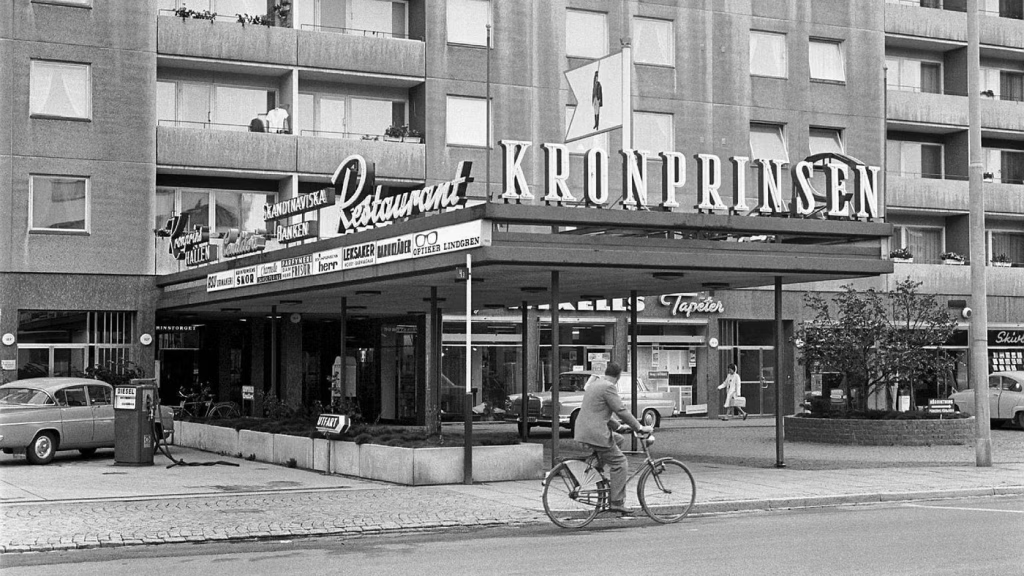
Kronprinsens restaurant - where Garland, Horne, Borge and Baker came to show
KRONPRINSENS RESTAURANG
Malmö’s legendary show restaurant where the stars came to town
When Malmö learned to think big
There are restaurants that serve dinner, restaurants that provide entertainment – and then there are restaurants that become part of a city’s identity. Kronprinsens Restaurang was firmly in the third category.
For three extraordinary decades, from 1961 to 1991, the restaurant at Malmö’s spectacular Kronprinsen complex was one of Sweden’s leading show restaurants. International stars shared its stage with the biggest names in Swedish entertainment, and an evening at Kronprinsen could feel less like a restaurant visit and more like a trip to the West End, Las Vegas and Stockholm – without leaving Malmö.
The setting was almost as dramatic as the performers. When the Kronprinsen complex was completed in 1964, its 27-storey tower dominated Malmö’s skyline. Building entrepreneur Hugo Åberg had imagined a modern city-within-the-city, inspired partly by American skyscrapers and Milan’s Palazzo Pirelli. The complex offered shopping, food, entertainment, sport, offices, homes and even its own television operation.
And down below was the show restaurant that helped give the entire project its glamour.
The golden years
Although the tower was completed in 1964, the restaurant’s celebrated show era began in 1961. The period from 1961 to 1991 is now regarded as a golden chapter in Skåne’s entertainment history.
Kronprinsen had an advantage that many competitors could only dream about: scale. It could bring major performers to Malmö and give them a proper stage, a large audience and an atmosphere that combined dinner with live entertainment.
The audience came dressed for the occasion.
This was not simply “going out for a meal”. It was an evening. You booked a table, ate, drank, watched the show and waited for the applause. The restaurant became a place where Malmö residents could see artists they might otherwise have had to travel to Stockholm, Copenhagen or further afield to experience.
The guest list eventually became extraordinary.
Hollywood comes to Malmö
Among the international megastars associated with Kronprinsen were Judy Garland, Josephine Baker, Lena Horne and Victor Borge.
Imagine the contrast: Malmö in the 1960s, still a strongly industrial Swedish city, and on stage at its most fashionable show restaurant stood artists whose names belonged to international entertainment history.
Judy Garland alone was enough to give any venue legendary status. Josephine Baker brought with her a career that had stretched across Paris, Broadway and international cabaret. Lena Horne was one of America’s great singers and performers. Victor Borge could turn a piano recital into a comedy performance and a comedy performance into a musical masterclass.
Kronprinsen did not merely book “international acts”. It booked stars.
And the Malmö audience knew it.
The Swedish stars were no less dazzling
The international visitors were only half the story.
Kronprinsen became a home for Sweden’s own entertainment royalty: Povel Ramel, Hasseåtage, Jan Malmsjö, Siw Malmkvist, Eva Rydberg, Östen Warnerbring, Sven-Bertil Taube, Lill-Babs and many others.
Povel Ramel was particularly associated with the restaurant. His PoW Show II premiered at Kronprinsen in February 1974, while his KaRAMELodier and later shows also appeared there. The restaurant could therefore be both a showcase for international stars and a laboratory for Swedish entertainment.
It was a remarkable combination.
One night you could watch a performer who had conquered Hollywood; another evening you could see one of Sweden’s greatest comedians or revue artists trying out something new.
Kronprinsen had become Malmö’s entertainment embassy.
An elephant walks into a restaurant…
Every legendary venue needs stories that sound too strange to be true.
Kronprinsen has several.
One of the most famous involved a genuine elephant. The elephant, named Tanja, actually appeared as part of the entertainment at the restaurant.
This was the era before every event had to pass through several layers of risk assessment, insurance paperwork and committee approval. Apparently, the answer to the question “What should we do to make tonight’s show unforgettable?” could occasionally be: “How about an elephant?”
Then there was the occasion when Lill-Babs was surprised for her 40th birthday.
And another memorable episode involved Lasse Åberg, who apparently arrived without the expected formal jacket and almost failed to get past the door.
It is difficult to imagine a more wonderfully old-fashioned problem.
Today, a celebrity without a jacket might simply be photographed in it. At Kronprinsen, the question was apparently whether he was dressed well enough to get inside.
The stories were part of the experience.
A restaurant inside a city in the sky
What made Kronprinsen different was the entire environment.
The complex was designed as a modern lifestyle centre long before that phrase became fashionable. The shopping centre below offered a remarkable collection of services and shops. There were sporting facilities, bowling, offices, homes and restaurants. At the top was Restaurang Översten, with its panoramic views over Malmö.
There was even television.
Kronprinsen operated its own commercial local-TV service from a studio high in the tower. Artists appearing at the show restaurant could sometimes be brought upstairs to take part in broadcasts. According to Kronprinsen’s own history, the operation continued for 25 years and was one of the earliest commercial local-TV initiatives of its kind in Scandinavia.
So the building did not simply host entertainment.
It produced, filmed, promoted and distributed it.
Kronprinsen was almost a small media empire disguised as a shopping centre.
The art of the long evening
The great Swedish show restaurants belonged to a particular era of nightlife.
Dinner was not something to squeeze between work and bedtime. It was an event. The room filled gradually. Jackets and dresses appeared. Waiters moved between tables. Glasses were raised. Conversation became louder as the evening progressed.
Then the lights changed.
The orchestra or musicians started.
The curtain opened.
For the next hour, the audience belonged to the performer.
And afterwards came the inevitable question: “Who did you see?”
At Kronprinsen, the answer could be enough to make someone at the next table jealous.
The restaurant became a social meeting place for Malmö’s business community, entertainers, celebrities and ordinary theatre-loving residents. In many ways, it was a city’s living room – only considerably better dressed.
The beginning of the end
But even the greatest show eventually reaches its final act.
The entertainment industry changed dramatically from the late 1980s onward. Television became more powerful. New concert venues and nightlife concepts appeared. Restaurant economics changed. Audiences became less willing to commit an entire evening to the traditional dinner-and-show format.
Kronprinsen’s old magic gradually became harder to reproduce.
The restaurant’s celebrated show period is generally dated to 1961–1991. Later, other restaurant operations occupied parts of the complex, including Malou in the 1990s. Contemporary memories show that the old institution still had devoted supporters, but the era of the huge star-driven show restaurant had passed.
By the end of the 1990s, the famous show restaurant had closed.
The stage went dark.
The audience went elsewhere.
The fall of an entertainment empire
The decline of Kronprinsen mirrored the decline of an entire style of Swedish nightlife.
What had once seemed wonderfully glamorous could eventually look old-fashioned. The grand dinner, the orchestra, the revue, the formal dress and the famous guest were replaced by faster, more informal and more fragmented forms of entertainment.
The Kronprinsen complex itself also struggled during later decades. Several spaces stood empty, the shopping centre lost some of its former lustre and the once-revolutionary building began to look increasingly tired.
Yet the building survived.
That matters.
Because unlike many demolished entertainment palaces, Kronprinsen remains physically present in Malmö. Its blue mosaic façade still recalls the optimism of the 1950s and 1960s, when the city believed the future should be taller, brighter and more spectacular.
The legend refuses to close
In recent years, Kronprinsen has undergone a major renovation, including a restoration of its distinctive façade. The result has brought new life to a landmark that had spent years looking rather tired.
The old show restaurant may be gone, but its story has been rescued from oblivion by photographs, memories and, above all, Christer Borg’s extensively illustrated history Alla var där – från Nisse Ahlrot till Judy Garland.
The title says almost everything.
Everyone was there.
From local entertainers to international megastars. From Povel Ramel and Hasseåtage to Judy Garland and Josephine Baker. From elegant dinner guests to performers arriving with costumes, instruments – and occasionally an elephant.
The last curtain call
Imagine Malmö around 1970.
The Kronprinsen tower rises above the city like something imported from New York. Inside, the restaurant is filling up.
A waiter checks the tables.
The band is ready.
Someone has just arrived from the railway station. Someone else has spent too long in the bar. A celebrity is backstage. A local businessman is hoping his guests are impressed.
Then the lights dim.
The room becomes quiet.
The curtain opens.
For a little while, Malmö is the centre of the entertainment universe.
That is the enduring magic of Kronprinsens Restaurang.
It was not simply a place where famous people performed. It was a place that convinced an entire city that it deserved the stars.
And the stars came.
Judy Garland. Josephine Baker. Lena Horne. Victor Borge. Povel Ramel. Hasseåtage. Lill-Babs. Eva Rydberg. Sven-Bertil Taube. Siw Malmkvist. And countless others.
The restaurant eventually disappeared.
The building changed.
The audiences grew older.
But somewhere in Malmö’s collective memory, the lights are still going down, the orchestra is tuning up and the next great name is waiting behind the curtain.
At Kronprinsen, the show may have ended.
The legend never did.
Editorial research note: The chronology and artist references have been cross-checked against Malmö City, Kronprinsen’s own historical account, and Christer Borg’s Alla var där – från Nisse Ahlrot till Judy Garland, which documents the restaurant’s 1961–1991 show era.