
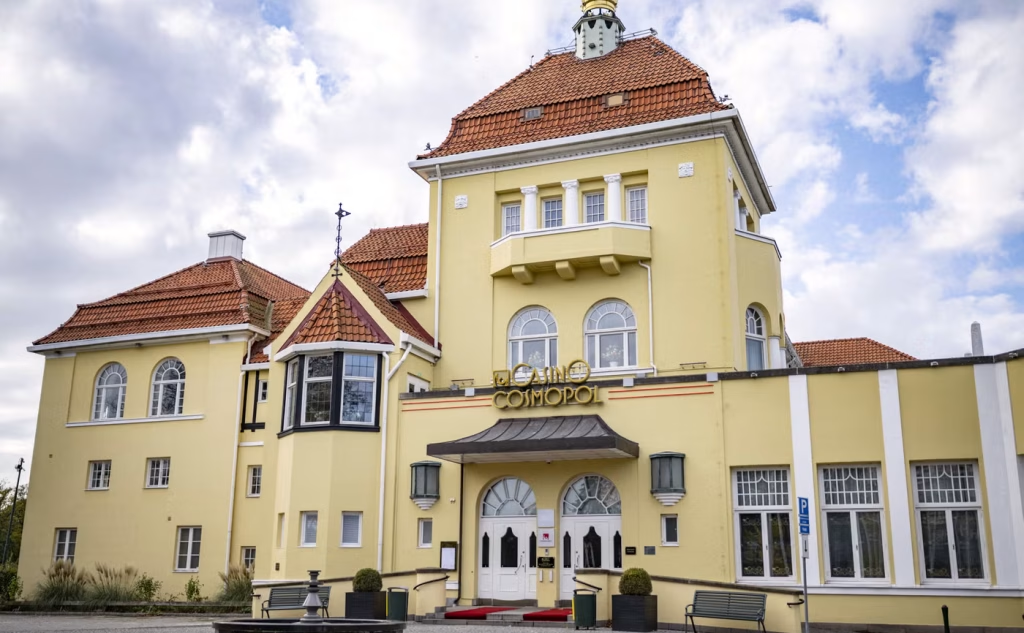
Kungsparkens restaurang - when gambling came to town
KUNGSPARKEN
The restaurant that refused to have just one life
An editorial special on Malmö’s grand old dining room, its rise and fall, and the glittering Casino Cosmopol chapter.
A palace of lunch, laughter and luck
There are buildings in Malmö that seem to have been designed with a single purpose. The old Kungsparken restaurant was never one of them. It has been a royal calling card, a grand restaurant, a fading pleasure palace, a student-era haunt, a casino and, finally, a monument to the city’s habit of reinventing itself.
Its story begins before the first roulette ball ever spun. Kungsparken was created in the late 1860s on land that had belonged to Malmöhus’s fortifications. The park opened to the public in 1872, originally as Slottsparken, and was conceived in the romantic English-park tradition: winding paths, exotic trees, water, grottoes and carefully staged views. It was greenery with a lesson plan. Even the trees were labelled, as if Malmö’s citizens had been invited to dinner at a botanical garden.
Then came the restaurant. In 1881, a two-storey wooden pavilion in elaborate Swiss style rose at the park’s highest point. King Oscar II inaugurated it during Malmö’s great agricultural exhibition. The royal visit gave the park a new official name — Kung Oscars park — although ordinary Malmö people, displaying the usual democratic impatience with official nomenclature, simply called it Kungsparken.
That little naming story says something about the place. The king could provide the ceremony; Malmö supplied the nickname.
When Kungsparken was a destination
The original pavilion was not modest. Its carved timber ornament, elevated position and views towards the park, the plain and Öresund made it the sort of place where lunch could quietly become an afternoon. A large veranda was added for the 1896 industrial exhibition. By the early twentieth century, however, the old wooden restaurant was showing its age.
The decisive makeover came around the Baltic Exhibition of 1914. The timber exterior was largely removed, the stone core was retained, and architects August Ewe and Carl Melin created the more substantial restaurant building associated with the Kungsparken legend. The result was sufficiently grand that calling it a mere “pavilion” no longer seemed adequate. It became Restaurang Kungsparken.
In 1920 the building was enlarged again. For decades it was one of those Malmö places that did more than serve food: it hosted dinners, societies, celebrations and formal gatherings. Contemporary traces show just how busy its social life could be — spring feasts, banquets, speeches and the sort of “nachspiel” that makes an old guest list sound suspiciously more entertaining than a modern calendar.
And this is where the anecdotes begin to matter. Kungsparken was built for respectable bourgeois strolling, but respectable Malmö has never been quite as respectable as its park signs suggested. The original park even had strict rules about who could enter and when, including the charmingly severe requirement that small children be accompanied by an older person. Imagine being turned away from a park because your guardian was insufficiently grown-up — before you had even reached the restaurant.
The long goodbye
The post-war city was less enchanted by the old restaurant. By the 1960s, interest in the traditional restaurant operation had declined. The grand dining room no longer occupied quite the same place in Malmö’s imagination. The building had survived fashion, but fashion was beginning to move elsewhere.
Yet Kungsparken refused to disappear. It continued in other forms, including a period associated with student life, and in 1985 underwent a major renovation when the building was in poor condition. The restaurant’s old role as a social magnet was fading, but the architecture was stubbornly alive.
There is a particularly Malmö quality to this chapter: when a grand restaurant stops being fashionable, the building does not necessarily die. It gets another job.
Enter Casino Cosmopol
The most improbable second act arrived in 2001. The old restaurant was transformed into Casino Cosmopol, part of Sweden’s new state-backed international casino experiment. The conversion reportedly cost about SEK 60 million, and when the Malmö casino opened in December 2001, it arrived with the confidence of a new century: gaming tables, slot machines, restaurants, nightlife and the promise of an international experience in the middle of Kungsparken.
At opening there were 22 gaming tables and 198 slot machines. The symbolism was almost too neat. A building once designed for polite promenades and ceremonial dinners was now selling suspense by the minute.
The casino years produced their own strange poetry. The old restaurant’s rooms became places where fortunes could change without anybody raising their voice. A blackjack table could sit where an earlier generation had raised a dinner glass. The building had gone from royal inauguration to bourgeois banquet to student life to roulette — a career path unlikely to be recommended by any heritage architect, but irresistible in retrospect.
There was also a darker, more practical side. Casino Cosmopol operated under Sweden’s regulated gambling system and emphasized responsible gaming. Staff worked to identify people at risk of gambling problems and guide them towards help. Behind the glamour was a highly controlled workplace — the opposite of the carefree mythology surrounding casinos.
And then the wheel stopped
The casino’s decline was not caused by one dramatic scandal. It was something quieter and, in its way, more modern: people stopped needing to go somewhere to gamble. Online gaming grew, visitor numbers weakened and profitability deteriorated. Then came the pandemic. Malmö’s casino was forced to close for roughly fifteen months, and according to its final manager, Yared Gabretensaye, the audience never fully returned.
In January 2024, Svenska Spel announced that Malmö and Gothenburg would be closed because of poor profitability. Malmö’s final night came on 24 February 2024, ending more than two decades of Casino Cosmopol in the building.
The aftermath was almost cinematic. In March, staff were dismantling the casino. Machines stood wrapped in plastic. A blackjack table had become, for the moment, a workbench and gathering place for screws and tools. Some equipment was destined for auction; other gaming equipment could not simply be sold to private buyers for obvious reasons. The casino that had once been built to create an atmosphere of anticipation was being reduced to inventory.
What remains
Kungsparken itself is still Malmö’s oldest public park, and the building remains part of a much older story than casino culture. In 2025, Malmö Konstmuseum began using the former restaurant space for temporary activities, historical tours, workshops and cultural programming while exploring a possible future for the site.
That may be the most fitting twist of all. Kungsparken’s old restaurant has never really been about restaurants. It has been about what Malmö wants a public building to mean at a particular moment.
In 1881, it meant royal modernity. In the early twentieth century, it meant dining and ceremony. Later, it meant decline, student life and reinvention. In 2001, it meant glamour, regulation and the seductive mathematics of chance. After 2024, it became a question mark.
And perhaps that is why Malmö remembers it so fondly. Kungsparken was never merely a place where you ate, drank, danced or gambled. It was a place where the city watched itself change.
The roulette wheel is gone. The old stories are not.
Somewhere beneath the modern layers, you can still imagine the original restaurant pavilion looking out over the park — waiting, as it has for nearly a century and a half, for Malmö to decide what happens next.
Research note
This editorial is based on Malmö stad’s historical material on Kungsparken and the former restaurant, Malmö municipal planning/history documents, SVT reporting on the Casino Cosmopol opening and closure, Sveriges Radio reporting and Svenska Spel’s published account of the casino shutdown. A few humorous observations and transitions are editorial colour rather than claims of specific documented incidents.