
Översten - classic menu with a view to die for
ÖVERSTEN, MALMÖ
The legendary restaurant that put the city at its feet
A nostalgic editorial special on Kronprinsen’s once-famous sky-high dining room, its panoramic views, and the end of an era.
A restaurant above the everyday
In Malmö, a restaurant could serve lunch, dinner and a little theatre simply by taking the lift. Översten, perched on the 26th floor of Kronprinsen, was never just another place to eat. It was a destination with a built-in wow factor: step out of the lift, find a table by the windows, and watch Malmö spread beneath you like a living map.
At roughly 73 metres above street level, the restaurant offered a perspective that most city restaurants could only dream about. Rooftops, church spires, parks and the shifting blue-grey expanse of Öresund formed the scenery. On a clear day, the view seemed to stretch towards the horizon; when the weather turned moody, the city took on the dramatic atmosphere of a film set. At Översten, even waiting for your food could become part of the entertainment.
Kronprinsen: a bold vision in blue
The restaurant’s story is inseparable from the building that carried it. Kronprinsen was completed in 1964, rising 27 storeys above a site once occupied by the Kronprinsens husarregemente. Developer Hugo Åberg and architect Thorsten Roos imagined more than a tower: the project was intended as a “city within a city”, bringing homes, shops, offices, services and leisure under one roof.
Its blue tiled façade, graduating in tone towards the sky, made the building one of Malmö’s defining modernist landmarks. The idea of a restaurant high above the streets was part of that confident, forward-looking vision. In the 1960s, Kronprinsen represented a city looking ahead, and Översten was its crown jewel—a place where a special occasion could feel genuinely elevated.
The name itself, Översten, means “the colonel”. It was a fitting title for a restaurant that seemed to command the city from its lofty post, even if its most memorable weapon was not military precision but the view.
A move to the top—and a long run
Översten’s later chapter became closely associated with restaurateurs Monica and Peter Kentell. In 1997, they moved the restaurant to Kronprinsen after running Drabanten at the top of the Hyllie water tower for 25 years. They were hardly newcomers to the business of serving meals with a view.
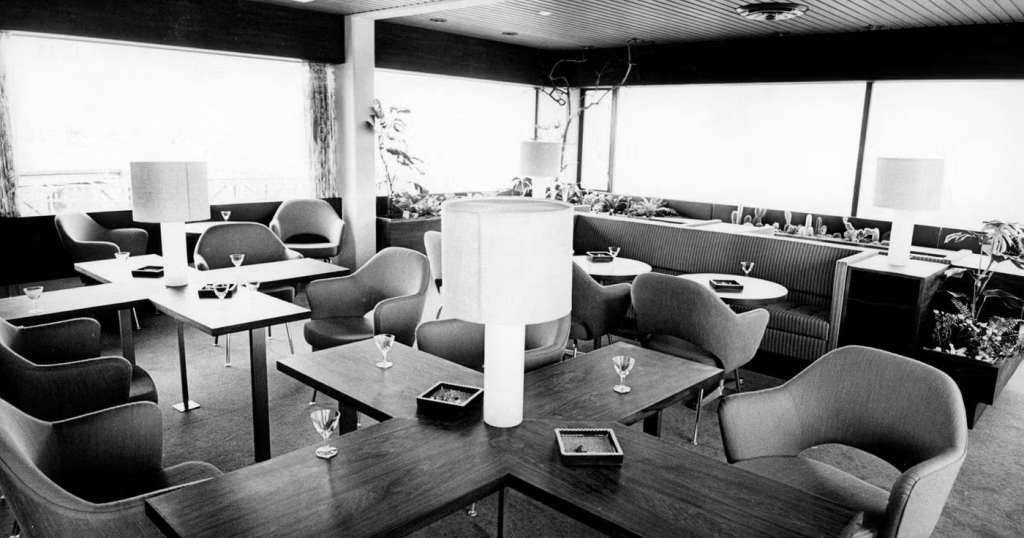
By then, the city around Kronprinsen was changing. Malmö’s skyline would eventually acquire newer landmarks, most famously Turning Torso, but Översten retained a special place in local memory. It was not a fashionable glass-box sky bar trying to look international. Its appeal was more individual: traditional Swedish cooking, a recognisable retro interior, regular customers and the reassuring sense that the view would be spectacular even if the menu was familiar.
The restaurant served lunch and à la carte meals, hosted festive buffets and built traditions around occasions. Fridays could mean a generous shrimp feast; Sundays brought brunch, waffles and an extravagant dessert spread. There was even a chocolate fountain—an attraction that gave children and grown-ups alike a perfectly respectable excuse to linger by the dessert table. For a restaurant famous for its panoramic views, it understood that a little edible theatre never hurt.
The view was the star of the show
Översten’s greatest luxury was impossible to plate up. It was the changing panorama beyond the glass. Guests could watch the light move across the city, follow the weather rolling over the Sound, or try to identify familiar neighbourhoods from an unfamiliar angle. The restaurant could make an ordinary lunch feel like a mini excursion.
The windows also gave the place its own social atmosphere. Business lunches acquired a grander backdrop; birthdays and family gatherings came with a ready-made talking point; visitors could be introduced to Malmö without first putting on their coats. A table near the window was the prize, and conversation had a habit of pausing whenever someone noticed something new outside.
There was humour in the contrast, too. A restaurant so high above the pavement still had to deal with the most down-to-earth concerns: whether everyone had arrived, whether the lift was behaving, and whether there was room for one more helping. The journey up might have felt like an expedition, but the welcome was meant to be familiar. That combination—spectacle outside, everyday hospitality inside—was part of Översten’s charm.
Not every legend is polished silver
Nostalgia should not turn any restaurant into a fairy tale. Översten’s reputation was built on more than one thing, and not every guest remembered the food with the same enthusiasm. Reviews and recollections ranged from affection for the service and the unusual setting to criticism of particular dishes or the dated feel of the room. In that way, it was a very real restaurant, not a museum piece: loved by some, debated by others, and capable of prompting strong opinions over coffee.
Yet the slightly time-capsule quality eventually became part of its identity. At a moment when many venues were chasing minimalist interiors and ever-new concepts, Översten’s retro atmosphere could feel delightfully out of step. What some saw as old-fashioned, others experienced as character. The view was timeless; the furnishings belonged to another era; the combination was unmistakably Översten.
The end of the climb
The restaurant’s final chapter came with the major renovation of Kronprinsen. The building’s ageing façade needed extensive work, and the redevelopment changed the uppermost levels. The restaurant and the public viewing experience that had been part of the building’s story were discontinued as the top floors were converted into duplex apartments.
The change was about more than the loss of a business. For decades, the upper floors had offered ordinary Malmö residents a chance to look out over their own city from a remarkable vantage point. In 2020, Malmö City publicly expressed an ambition to preserve public access to the panoramic view. But the eventual renovation brought the restaurant era to an end, and the former public destination gave way to private homes.
A city is always changing, and buildings must be maintained. Still, there was an undeniable irony in a landmark once designed to bring different parts of urban life together losing one of its most distinctive public spaces. The lift no longer carries diners to a table where the city is the main course.
A Malmö memory with a view
Översten’s legacy is not simply that it was high up. Plenty of buildings are tall; far fewer turn height into a shared experience. The restaurant made the skyline part of a meal and gave generations of guests a reason to celebrate, meet, look outwards and see Malmö from a different angle.
Its story also reflects the city itself: bold modernist ambition, changing tastes, loyal regulars, a little kitsch, a little glamour, and the steady pressure of redevelopment. The chocolate fountain may have supplied the sweetest anecdote, but the view was the real signature.
Today, Översten belongs to memory rather than the restaurant listings. Those who visited can still recall the lift ride, the first look through the windows, and the small thrill of seeing familiar streets far below. For a while, Malmö had a dining room in the sky. And when the plates were cleared, the city itself was always waiting outside the window.
Editorial research note: Historical details checked against Malmö City’s architectural history of Kronprinsen, Kronprinsen’s official history, contemporary reporting on Översten, and later accounts of the building’s renovation.