
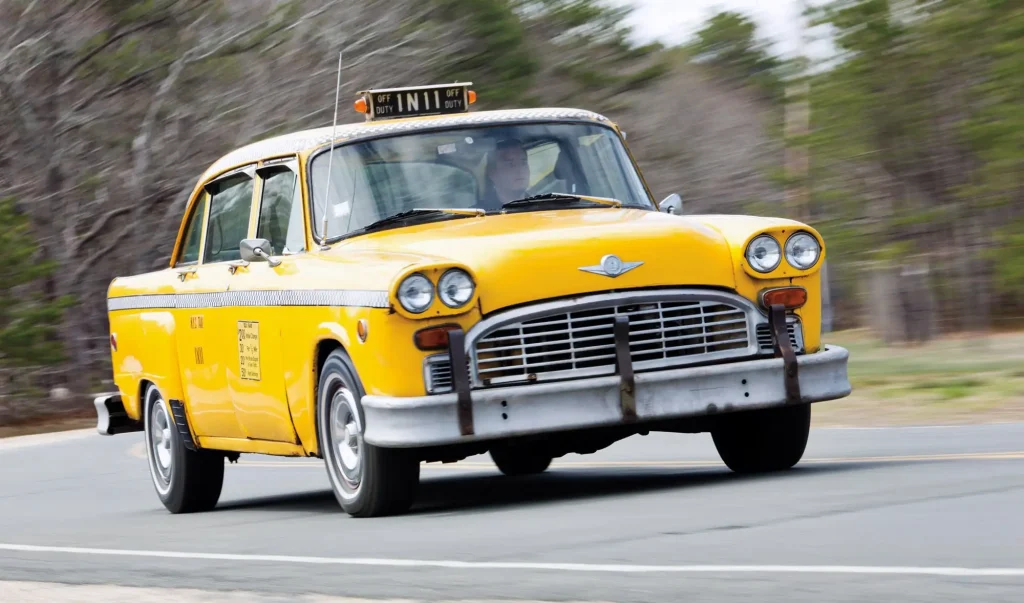
Roy's Taxi - when classic New York yellow Checkers came to town
THE YELLOW CHECKER THAT DARED TO BE DIFFERENT
Roys Taxi and the Malmö streets that still remember
An editorial special on a home-grown taxi legend: its rise, its swagger, and the long road from independence to nostalgia.
A different kind of yellow
In Malmö, the best local legends rarely arrive wearing a crown. Sometimes they arrive at the kerb in a yellow taxi. For a certain generation, Roys Taxi was not simply a way to get from A to B; it was a small declaration of independence on four wheels. The name carried a particular charge: Roy’s, not the big boys’. The true Yellow Checker.
That phrase sounds like it belongs on a badge, a garage wall or the side of a well-loved car. It conjures the golden age of taxis: big-hearted machines, drivers with opinions, and passengers who began a journey as strangers but stepped out with a story. Roys Taxi had the aura of a challenger that knew exactly who it was—and was quite happy for the rest of the city to find out.
The rise of Roy
Behind the name was Roy Gasper, described in a Swedish publication from the 1980s as a taxi driver originally from New Guinea who had built a notably successful operation in Malmö. The same account portrayed Roys Taxi as a breakaway from the city’s dominant taxi association, competing on price and service. In a city where the established order had long held the dispatch phone, that was no small move.
Roys Taxi was already being discussed as a competitor before Sweden’s wider taxi-market deregulation in 1990. An academic study of the regulated market later pointed to Roys as an example of a competitor that appeared in Malmö even before deregulation. In other words, Roy wasn’t waiting for the rules to change before trying a different route. He was already on the road.
That is the classic underdog plot. A large incumbent has scale, a name everyone knows, and the comforting weight of habit. The newcomer has nerve, a different pitch and the dangerous belief that customers might actually enjoy having a choice. The newcomer’s office may be smaller, but the ambition is not.
What made it a ‘true Yellow Checker’?
To call Roys Taxi a true Yellow Checker is to evoke more than paintwork. It suggests a cab with a recognisable identity, a working vehicle rather than a fashion accessory, and a driver who knew that the journey was also a performance. A taxi is one of the few places where a city’s social classes, night owls, business travellers, students, newlyweds and people who have just made a terrible decision all share the same upholstery.
Yellow is a practical colour: hard to miss, especially when the weather turns Malmö grey. But it is also a promise. Here is your ride. Here is your escape from the rain. Here is a moving confessional with a meter. The ‘Checker’ part adds a little old-world toughness, calling to mind the square-shouldered American taxi icons built to take years of passengers, luggage, spilled coffee and stories that get taller with every retelling.
Whether the passenger wanted a quick trip across town or a late-night debate about football, politics or the meaning of life, the taxi driver was often the city’s unofficial commentator. A good driver could read a passenger in three seconds. A great one could tell from the way the door closed whether the customer wanted conversation, silence, or to explain the entire evening from the beginning.
Malmö, seen from the back seat
Picture a fictional but entirely plausible Roys Taxi scene. It is raining sideways. A passenger dives in and announces, ‘I’m in a terrible hurry.’ The driver glances at the traffic, then at the passenger. ‘Then you picked an excellent city for character development.’ The passenger laughs despite themselves. The meter starts; so does the story.
Or imagine two people leaving the same party, each convinced they had the more important conversation of the evening. By the time they reach their destinations, both have told the driver their version. The driver, naturally, knows the truth—but keeps it to himself. Taxi drivers have always been the custodians of other people’s secrets. Their greatest professional skill may be the ability to say ‘Jaså?’ in a tone that means absolutely nothing and everything.
These are invented vignettes, not historical quotations. But they capture the social theatre that made a distinctive local taxi company more than a fleet. People remember the car, certainly. They also remember the driver who knew a shortcut, the voice on the phone, the familiar colour at the kerb, and the reassuring feeling that someone local was in charge.
The hard business of staying independent
Of course, swagger does not pay every invoice. A taxi company needs cars, drivers, permits, dispatch, maintenance and enough fares to keep the wheels turning. Competing with an established operator is not just a matter of having a better slogan; it means persuading customers to call you, finding a place in the dispatch system and negotiating the rules of an industry where access can matter as much as the vehicle itself.
Roys Taxi’s history intersected with those very questions. A European human-rights case concerning Swedish taxi arrangements records disputes involving the Roys Taxi Economic Association and access to a supplementary dispatch exchange, against the background of a common dispatch system run by Malmö’s taxi central. The legal details are less romantic than a yellow cab gliding through the night, but they tell an important part of the story: independence is easy to celebrate and much harder to organise.
Then the market changed. Sweden’s taxi deregulation in 1990 brought a new competitive landscape. More choice can be good for passengers, but it can also intensify pressure on prices, recruitment, service and identity. The little operator must compete not only with the established giant, but with every new business model that promises to get a car to the kerb faster or cheaper.
The fall—or the long fade into legend
The rise of Roys Taxi is easier to trace than a single, definitive moment of decline. The public record does not offer a neat final scene: no cinematic last shift, no confirmed farewell procession of yellow cars, no driver leaning on the bonnet as the sun sets over the Öresund. It is more honest to describe the ‘fall’ as the fading of a distinctive era and the difficulty of preserving an independent identity in a changing taxi market.
That kind of ending is familiar to every city. First, the old name is part of daily life. Then it becomes something people mention when comparing how things used to work. Eventually, someone younger asks, ‘Roys Taxi? What was that?’ and a veteran begins a story with the words, ‘You had to be there.’ At that point, a company has become folklore.
Perhaps the most fitting tribute is not to pretend that every journey was perfect or every business decision brilliant. Legends are not made by flawless spreadsheets. They are made by being recognisable, by taking a chance, by giving people an alternative—and by leaving enough memories that the name survives long after the last dispatch call.
A yellow streak through Malmö history
Roys Taxi belongs to a more personal version of urban life, when a local company could build its reputation one conversation, one pickup and one safe arrival at a time. Its story is about Roy Gasper’s entrepreneurial nerve, the challenge to an established order, and the awkward truth that a good idea still has to survive the economics and rules of the road.
So raise an imaginary coffee to the true Yellow Checker: to the drivers who knew the streets, the passengers who climbed in with a plan and climbed out with a story, and the people who remember a yellow cab as a symbol of something more than transport. Not every legend needs a monument. Sometimes all it needs is someone pointing at an empty stretch of kerb and saying, ‘You remember Roys Taxi?’
And if the answer comes with a grin, a story and a wildly disputed detail about a night in Malmö, then the legend is still running.
Editorial note: The article uses the user-provided description ‘true Yellow Checker’ as a cultural motif. Humorous taxi scenes are explicitly fictional composites, not verified incidents or quotations. Available sources do not establish a precise closure date or a single definitive cause of decline.