
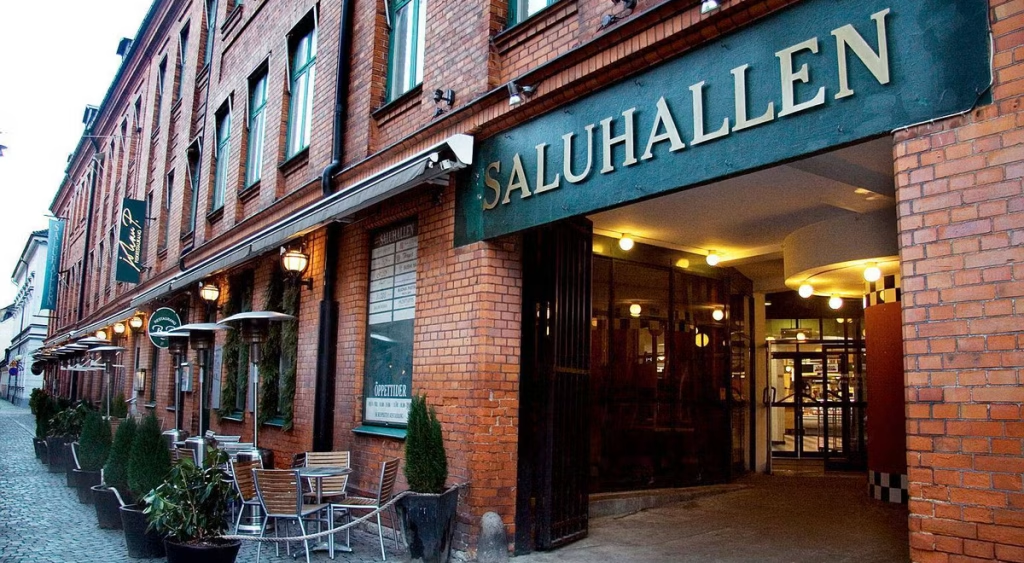
Saluhallen - How three became one food paradise
SALUHALLEN
The Malmö food hall that refused to disappear
There are few places that tell the story of a city quite like a saluhall. Behind the counters, between the shopping bags and under the smell of freshly baked bread, meat, fish and coffee, everyday Malmö revealed itself.
The story of Saluhallen in Malmö is also a story of change: from open-air markets and horse carts to hygienic indoor trading, from crowded food halls to supermarkets, and eventually back again to the idea that buying food can be an experience rather than a chore.
When Malmö moved indoors
During the second half of the 19th century, Malmö was expanding rapidly. Open-air markets had long been central to food supply, but they were increasingly difficult to reconcile with a growing industrial city. Meat, fish and dairy products needed better protection from cold, heat, dust and dirt, while concerns about hygiene and disease were becoming impossible to ignore.
The answer was the modern market hall.
At the beginning of the 20th century, Malmö built three major halls, all associated with city architect Salomon Sörensen. The first occupied a former cavalry riding hall at Drottningtorget. Then came the grandest of them all: the market hall at Lilla Torg, completed in 1903. Four years later, Södra Saluhallen opened on Föreningsgatan.
The Lilla Torg hall was particularly dramatic. It covered virtually the entire square, replacing the collection of smaller market stalls and buildings that had served Malmö’s traders for generations. Before the hall, different trades had traditionally occupied different sides of the square: butchers, bakers, fish sellers and grocers each had their own territory.
For shoppers, the new hall meant a roof, cleaner conditions and an impressive concentration of food under one roof. For the traders, it meant a new stage.
And like every good stage, it had its characters.
The original food influencers
The old saluhall was not a restaurant in the modern sense. It was where Malmö came to buy dinner.
The personalities were the butchers, fishmongers, bakers, cheesemongers and grocers standing behind their counters, together with the regular customers who knew exactly what they wanted and, quite possibly, exactly how they wanted it cut.
This was food retail before supermarkets removed much of the conversation from shopping. You did not simply pick something from a refrigerated shelf. You asked, negotiated, compared and listened. The hall was commerce, theatre and local information exchange rolled into one.
The architecture encouraged that sense of occasion. The Lilla Torg building was not a modest shed but a substantial city landmark, designed to dominate the square. Malmö had decided that food deserved proper architecture.
For several decades, it worked.
When the food hall lost its future
The decline was not caused by one dramatic event. It was the result of a new way of living.
The Second World War brought rationing and food shortages. Then came the post-war supermarket, self-service shopping and the growing dominance of department stores. The customer increasingly wanted convenience, standardisation and speed. The traditional saluhall offered something different: specialist traders, counters, personal service and a shopping experience that required a little more time.
By the 1950s and 1960s, Malmö’s great halls were losing their original purpose.
The hall at Föreningsgatan became an anti-aircraft workshop during the war and was later converted into a sports hall. Drottningtorgets saluhall closed in 1963 and became a tram museum. The Lilla Torg hall took perhaps the strangest route of all: in its final years it became a car showroom, with Wiklunds Bil selling brands including Citroën, Rover, Packard and Bentley. The magnificent food hall was gone by 1968.
It was a wonderfully Malmö solution to changing times: when people stopped buying meat inside the building, they could at least buy a car.
Lilla Torg changes its personality
Once the hall was demolished, Lilla Torg returned to being an open square. Its historic buildings were restored, and decades later the area developed into one of Malmö’s best-known restaurant and nightlife districts.
The irony is hard to miss. The square that had once concentrated Malmö’s food trade inside one building eventually became famous again for restaurants and outdoor dining.
The saluhall itself had disappeared, but the appetite for gathering around food had not.
There were attempts during the 1980s and 1990s to revive the traditional market-hall concept at various locations, including Föreningsgatan, Lilla Torg and Möllevången. None established a lasting successor.
For a while, it seemed the era of the Malmö saluhall really was over.
Then came the old railway warehouse
The comeback began in a building that had spent decades doing almost the opposite of feeding Malmö.
The old Godsmagasinet on Gibraltargatan dated from the late 19th century and had stood unused since the last train left in 1955. Martin and Nina Karyd, siblings behind the family-owned property company Annabostäder, saw its potential. Together with architect Gert Wingårdh’s firm, they developed a new market hall that would respect the industrial character of the warehouse while introducing a contemporary extension in Corten steel.
The ambition was not simply to recreate 1903. The new hall would combine traditional counter-service food shopping with restaurants, cafés and modern food concepts.
Around 20 traders were brought together during the development process, with the emphasis on creating a carefully balanced mix rather than filling the building as quickly as possible.
On 11 November 2016, the doors opened.
The reaction was immediate. Curious Malmö residents crowded into the restored warehouse to inspect the new food destination, where flowers, tea, cheese, kitchen equipment, pizza and falafel could all be found under the same roof.
The new generation
Today’s Malmö foodhall is different from the grand saluhalls of the early 20th century, but the basic idea is surprisingly familiar.
The modern hall combines food shopping with eating out. Fishmongers can operate alongside restaurants; specialist producers share space with cafés and contemporary concepts. The emphasis is less on simply stocking the household pantry and more on discovery.
That makes room for a different generation of characters: chefs, bakers, baristas, fishmongers, cheesemongers and food entrepreneurs whose personalities are part of the attraction.
The result is closer to a culinary marketplace than a traditional supermarket. You can come for lunch, buy something for dinner, meet someone for coffee or simply wander around with no particular plan. The original saluhall required people to come together because that was how food shopping worked. The modern version has turned coming together into part of the product.
The great Malmö food circle
Perhaps the most interesting thing about Saluhallen is not that Malmö has rediscovered the market hall. It is that the city keeps rediscovering the same idea in different forms.
In the 1590s, Lilla Torg was created as a place for local trade. In 1903, that trade was brought under an impressive roof. In the 1960s, the hall disappeared as shopping habits changed. In 2016, the concept returned in a former railway warehouse, adapted for a city that now regards food as culture, entertainment and identity as much as necessity.
The buildings have changed. The traders have changed. The customers certainly have.
But the essential attraction remains remarkably constant: people like being around good food, and they like being around other people while they buy it.
That may be the real reason the saluhall never quite disappeared from Malmö’s imagination. The city can replace its markets, supermarkets, car showrooms and restaurants, but it keeps coming back to the same instinct — put good food in the middle of the city and let people gather around it.
The old hall at Lilla Torg is gone. The railway tracks at Gibraltargatan are long silent.
But the idea lives on.