
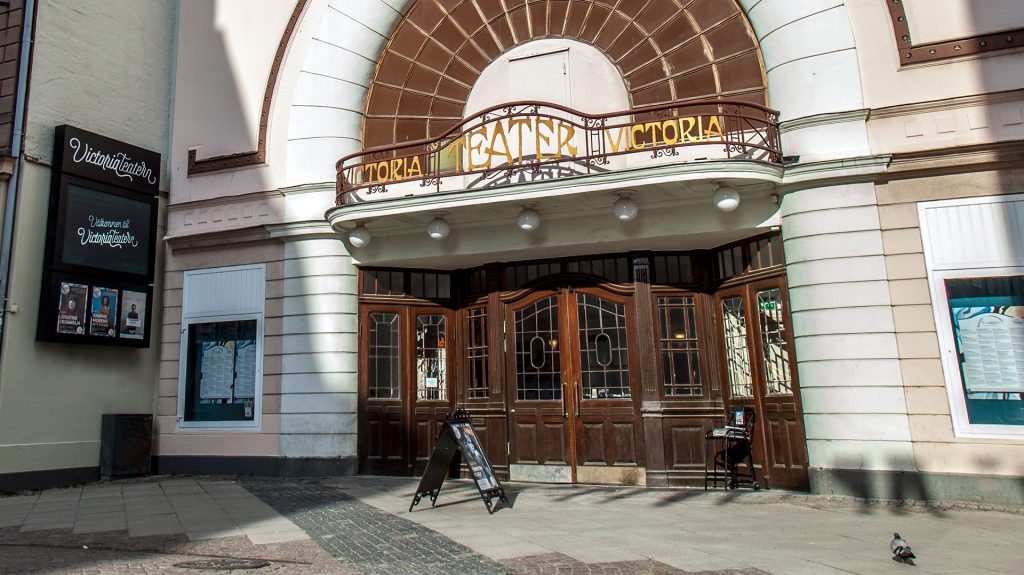
Victoria Theatre - historical memories and picknick theatre
Victoria Theatre, Malmö – The Little Stage That Refused to Die
An editorial special on cinema, comedy, rebellion and a century of unforgettable performances
A theatre with more than one life
Some venues become famous because of their size. Victoria Theatre in Malmö became legendary for the opposite reason: it has always felt close to the action. Situated on Södra Förstadsgatan, this compact cultural survivor has been a cinema, a revue theatre, a threatened relic and, finally, one of the city’s most distinctive live-performance venues.
Its story is not simply one of rise and fall. It is a tale of changing fashions, near-disappearance and an extraordinary comeback.
Victoria opened on 9 September 1912, designed and built by architect Axel Stenberg. Inspired by Stora Biografteatern, he created what was then Malmö’s largest and most magnificent cinema. Going to the pictures was a special occasion, and Victoria quickly established itself as one of the city’s leading destinations for film lovers.
In those days, however, films were silent. A small orchestra performed in a pit at the front of the auditorium, providing the musical drama. Imagine the musicians trying to keep pace with a film’s changing emotions: romance one moment, a desperate chase the next. There was no soundtrack button to press, no digital correction and certainly no opportunity to blame the technology if the timing went wrong!
The theatre originally had a horseshoe-shaped balcony and windows along its northern wall. During a renovation in 1916, the windows were bricked up to accommodate possible neighbouring development. But the city’s entertainment scene was already changing.
From silver screen to revue stage
By the early 1920s, larger and grander cinemas, including Palladium on Södergatan, had challenged Victoria’s position. The little theatre lost its leading role in Malmö’s silent-film world, although its central location and the continuing appetite for cinema helped it survive.
Then came a dramatic change of direction.
In the mid-1940s, the film screen and orchestra pit gave way to a proper stage. Victoria transformed into a revue theatre, bringing live comedy, songs and theatrical entertainment to Malmö audiences. The change was significant: instead of watching distant performers flicker across a screen, audiences could experience their favourite entertainers in the same room.
The revue years brought some well-known Swedish names. Sigge Hommerberg and “Dubbel-Olle” Ohlsson became associated with summer revues at the theatre. Thor Modéen appeared in Skånerapsodi 2 in 1948, followed the next year by Hjördis Petterson in Vår Tages Hage. Git Gay and Hans Lindgren were also among the performers associated with Victoria’s revue era.
Live comedy has always carried a particular risk. A joke that works brilliantly in rehearsal can fall flat before a real audience, while an unexpected laugh can throw an actor’s timing completely off. Unlike a film, a revue could not be edited after opening night. The performers and audience were in it together—and that unpredictability was part of the magic.
Yet the revue era proved relatively short-lived. By the mid-1950s, Victoria had returned to showing films.
The slow decline and the final screening
The 1960s were difficult years. Victoria was comparatively small and increasingly outdated as cinema-going habits changed and larger venues competed for audiences. The building that had once represented the height of modern entertainment was struggling to find its place in a new era.
In March 1974, SF screened its final film at Victoria and closed the cinema. The doors shut, and the building’s future became uncertain.
Demolition threatened the old theatre. To some, it was simply an outdated property whose useful life had ended. To others, it was an irreplaceable part of Malmö’s cultural memory.
The difference between those two perspectives would determine Victoria’s future.
The occupation that saved Victoria
In 1975, the Victoriakommittén was formed to campaign for the building to be transformed into a cultural centre. The campaign gathered momentum, and on 28 February 1976, activists occupied the theatre to prevent its loss.
Among the people associated with the occupation were musician Mikael Wiehe, writer and poet Lasse Söderberg, and a young Fredrik Gertten, who would later become known as a documentary filmmaker.
There is an almost theatrical irony in the episode. For decades, Victoria had presented dramas and comedies on its stage. Now, the building itself had become the setting for a real-life struggle, with its future hanging in the balance.
Instead of actors playing heroes, ordinary citizens stepped forward to defend a cultural landmark. Their argument was straightforward: a city should not measure the value of every historic building solely by its commercial potential.
The occupation attracted attention, and the campaign succeeded. Victoria was saved, and extensive restoration work followed. The venue reopened in 1981 as a multipurpose cultural centre for concerts, cinema and theatre. Kulturföreningen Kontrast took over the cinema programme in 1982 and the wider stage operation in 1990.
Victoria had been close to disappearing. Instead, it began its second life.
An international stage in an intimate room
As music became increasingly central to its programme, Victoria developed a reputation for something that large arenas often struggle to provide: intimacy.
Here, a performer can make eye contact with the audience. A quiet vocal can carry through the room, and an instrumental solo can feel like a personal conversation rather than a distant spectacle. Jazz, blues, folk, roots, world music, singer-songwriters and other forms of live entertainment have all found a home at Victoria.
Its international programme has introduced Malmö audiences to artists from many musical traditions. Cuban singer and pianist Daymé Arocena has been among the international names featured in the venue’s programming, while Finnish blues guitarist Erja Lyytinen has brought the energy of the Nordic blues scene.
A particularly striking example of international collaboration was Afro Cuban Supreme, led by Swedish saxophonist Fredrik Kronkvist. The project featured vocalist Miriam Aïda, American drummer Jason Marsalis and Cuban percussionist Eliel Lazo—a meeting of musicians and influences that demonstrated how naturally Victoria can accommodate cross-border musical conversations.
Other artists associated with its international programme include Jamaican singer and one-string guitarist Brushy One String, American roots-rock group The Delines, British soul singer Mica Millar and Bulgarian Voices Angelite.
These performers come from different backgrounds, but Victoria’s intimate setting gives them a shared advantage: their music can fill the room without being swallowed by it.
The theatre’s reputation was not built on one superstar or a single legendary evening. It grew through the steady promise of discovering something new—an unfamiliar sound, an unexpected musical tradition or an artist who might become a personal favourite.
A few Victoria-style surprises
Victoria’s history also reflects the changing ways audiences enjoy entertainment. In the silent-film years, musicians had to follow the action without a recorded soundtrack. During the revue era, performers faced audiences directly, with every laugh, pause and missed cue becoming part of the live experience.
Today, the venue continues to value that sense of closeness. Some performances use a relaxed café-style arrangement, and audiences can even bring their own food to designated picnic-style concerts.
It is a wonderfully informal combination: a historic theatre, an international performer and the possibility of enjoying your own supper while the music unfolds. One can only imagine what the musicians accompanying silent films in 1912 would have thought of it. They had to provide the soundtrack; today’s audience can bring the snacks as well.
The curtain stays up
Victoria Theatre has been many things: a glamorous early cinema, a stage for popular revue, a struggling film house and a threatened building rescued by determined citizens.
Its fall was real, but it was not the end. The occupation of 1976 changed the story, and the reopening in 1981 gave Malmö a cultural venue capable of evolving with the city rather than competing with its past.
More than a century after its doors first opened, Victoria remains a reminder that a cultural landmark need not be enormous to matter. Its value lies in the experiences it makes possible: a jazz performance that feels like a conversation, a voice from another country heard at close range, a shared laugh or the discovery of music that stays with you long after the evening ends.
The old theatre once faced its final curtain. Malmö refused to accept it.
At Victoria, the show goes on.